When we think of the micro-world of gems and minerals, we usually think of transparent to translucent host materials. However, there are also a number of opaque minerals used as gems that are composed of chemical elements such as copper, iron, and titanium. One of these is hematite.
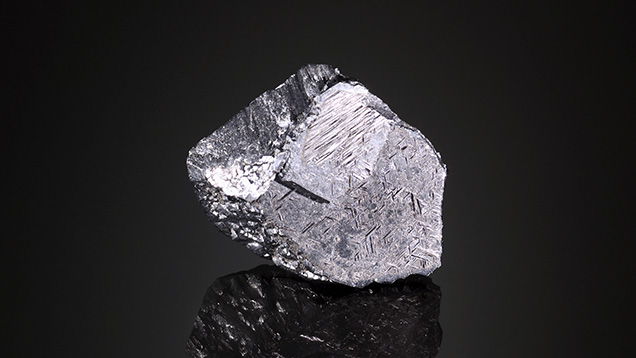
Recently we had the opportunity to study an unusual hematite crystal sent by Ali Shad of Shad Fine Minerals in Gilgit-Baltistan, Pakistan. The geographic source for the hematite crystal pictured in figure 1 is the Yangslo mine, located in the Basha Valley of Gilgit-Baltistan. At 178.33 ct and 39.83 mm in the longest direction, this “floater” hematite crystal (with no points of attachment to the surrounding rock) plays host to a sagenitic network of epitaxial, surface-oriented, opaque dark gray acicular rutile crystals as large as 4 mm in length.
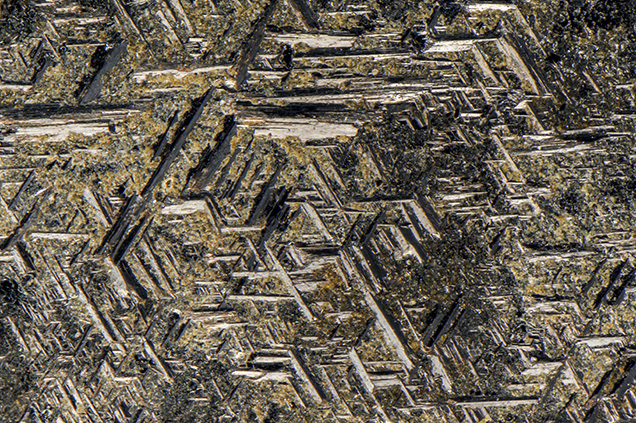
Using laser Raman microspectrometry, the identification of the sagenitic crystals was confirmed as rutile. Energy-dispersive X-ray fluorescence (EDXRF) analysis showed the dominant presence of iron and titanium, with a trace of manganese. As shown in figure 2, the euhedral rutile crystals were situated on the hematite crystal in the form of a geometric sagenitic boxwork.
When we think of the micro-world of gems and minerals, we usually think of transparent to translucent host materials. However, there are also a number of opaque minerals used as gems that are composed of chemical elements such as copper, iron, and titanium. One of these is hematite.
Recently we had the opportunity to study an unusual hematite crystal sent by Ali Shad of Shad Fine Minerals in Gilgit-Baltistan, Pakistan. The geographic source for the hematite crystal pictured in figure 1 is the Yangslo mine, located in the Basha Valley of Gilgit-Baltistan. At 178.33 ct and 39.83 mm in the longest direction, this “floater” hematite crystal (with no points of attachment to the surrounding rock) plays host to a sagenitic network of epitaxial, surface-oriented, opaque dark gray acicular rutile crystals as large as 4 mm in length.
Using laser Raman microspectrometry, the identification of the sagenitic crystals was confirmed as rutile. Energy-dispersive X-ray fluorescence (EDXRF) analysis showed the dominant presence of iron and titanium, with a trace of manganese. As shown in figure 2, the euhedral rutile crystals were situated on the hematite crystal in the form of a geometric sagenitic boxwork.