
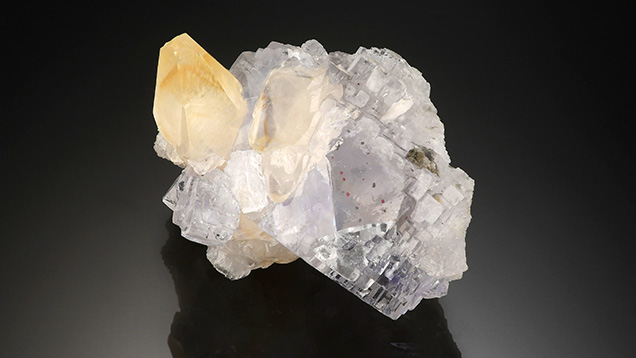
This issue's Quarterly Crystal deals with a 362.09 ct crystal cluster of fluorite and calcite recently examined by the authors. The 55.79 × 42.80 × 38.63 mm specimen was colorless and transparent to translucent and played host to several small bright red to dark red well-formed trigonal crystals, visible in figure 1. These crystals were all situated on the same growth plane in the fluorite portion.
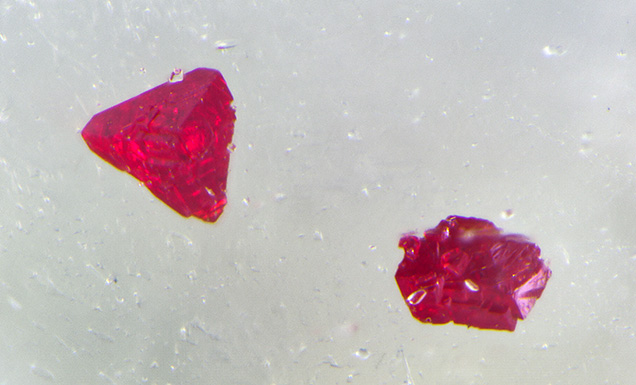
The fluorite and calcite specimen was obtained from Jordi Fabre of Fabre Minerals in Barcelona. It is from the Emilio mine in the Caravia mining area in the Asturias region of northwestern Spain. The Emilio mine is known to produce fluorite crystals with inclusions of various sulfides, including cinnabar. Therefore, the pure red bodycolor of these inclusions, together with the trigonal symmetry shown in figure 2, strongly suggested they were cinnabar. Using Raman microspectrometry, we were able to identify the inclusions as cinnabar, thereby confirming our initial impression.
John Koivula is an analytical microscopist, and Nathan Renfro is manager of colored stone identification, at GIA in Carlsbad, California.
This issue's Quarterly Crystal deals with a 362.09 ct crystal cluster of fluorite and calcite recently examined by the authors. The 55.79 × 42.80 × 38.63 mm specimen was colorless and transparent to translucent and played host to several small bright red to dark red well-formed trigonal crystals, visible in figure 1. These crystals were all situated on the same growth plane in the fluorite portion.
The fluorite and calcite specimen was obtained from Jordi Fabre of Fabre Minerals in Barcelona. It is from the Emilio mine in the Caravia mining area in the Asturias region of northwestern Spain. The Emilio mine is known to produce fluorite crystals with inclusions of various sulfides, including cinnabar. Therefore, the pure red bodycolor of these inclusions, together with the trigonal symmetry shown in figure 2, strongly suggested they were cinnabar. Using Raman microspectrometry, we were able to identify the inclusions as cinnabar, thereby confirming our initial impression.
John Koivula is an analytical microscopist, and Nathan Renfro is manager of colored stone identification, at GIA in Carlsbad, California.