
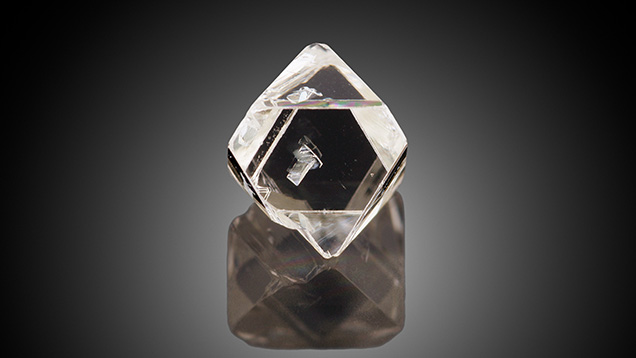
Mineral inclusions in diamonds are always very interesting to gemologists and other geoscientists, and the colorful minerals such as bright green chromium diopside and orange almandine-pyrope usually attract the most attention. This Quarterly Crystal is slightly different, in that the inclusion is both transparent and colorless, with relatively low relief compared to the diamond crystal host. The parent diamond, a transparent colorless, gem-quality glassy octahedron, weighed 0.71 ct and measured 5.88 × 3.99 × 3.01 mm (figure 1). Reportedly from South Africa, the diamond was purchased at the Tucson shows from David New.
When inclusion-host pairs are composed of the same mineral, it causes a low-relief situation bordering on invisibility. Such inclusions become visible when the orientation of the inclusion is different or when there is an interface or partial interface between the host and the inclusion. In the case of diamond in diamond, if the inclusion is visible, then the interface can consist of various fluids and gases, other minerals (most commonly graphite formed through graphitization), combinations of all of these, or nothing at all.
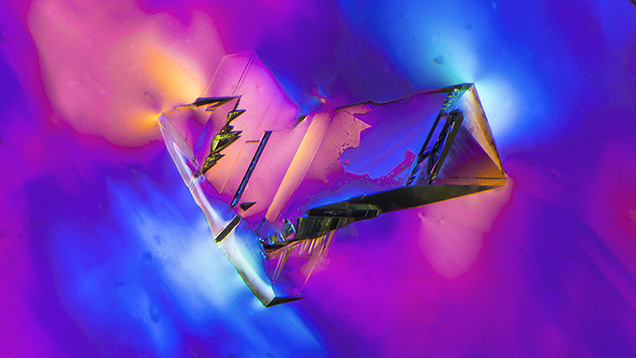
Examining the outline of the diamond inclusion in figure 2, there are areas at the interface where the inclusion and host diamond appear to blend perfectly and the interface seems to completely disappear. These are areas of perfect contact where the diamond inclusion and the diamond host merge, without any form of interfacial separation.
John I. Koivula is analytical microscopist, and Nathan Renfro is senior manager of colored
stone identification, at GIA in Carlsbad, California.
Mineral inclusions in diamonds are always very interesting to gemologists and other geoscientists, and the colorful minerals such as bright green chromium diopside and orange almandine-pyrope usually attract the most attention. This Quarterly Crystal is slightly different, in that the inclusion is both transparent and colorless, with relatively low relief compared to the diamond crystal host. The parent diamond, a transparent colorless, gem-quality glassy octahedron, weighed 0.71 ct and measured 5.88 × 3.99 × 3.01 mm (figure 1). Reportedly from South Africa, the diamond was purchased at the Tucson shows from David New.
When inclusion-host pairs are composed of the same mineral, it causes a low-relief situation bordering on invisibility. Such inclusions become visible when the orientation of the inclusion is different or when there is an interface or partial interface between the host and the inclusion. In the case of diamond in diamond, if the inclusion is visible, then the interface can consist of various fluids and gases, other minerals (most commonly graphite formed through graphitization), combinations of all of these, or nothing at all.
Examining the outline of the diamond inclusion in figure 2, there are areas at the interface where the inclusion and host diamond appear to blend perfectly and the interface seems to completely disappear. These are areas of perfect contact where the diamond inclusion and the diamond host merge, without any form of interfacial separation.
John I. Koivula is analytical microscopist, and Nathan Renfro is senior manager of colored
stone identification, at GIA in Carlsbad, California.