
Non-nacreous pearls are characterized by the absence of iridescent layers of nacre and are recognized for their distinctive surface characteristics. For some non-nacreous pearls, their unique look is attributed to the calcite structure’s patterning on the surface. Such structures can result in a wide range of surface appearances, predominantly featuring a cellular pattern, in contrast to nacreous pearls, which typically display overlapping aragonite platelets.
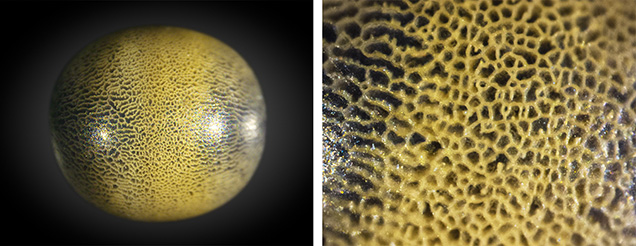
Recently, the authors examined a parcel of non-nacreous yellow, gray, brown, and black pearls of various shapes reportedly sourced from Pinctada radiata mollusks fished from Bahrain. Among the samples, an oval non-nacreous black pearl with grayish yellow areas at its center, weighing 0.085 ct and measuring 2.46 × 2.25 mm, stood out for its fascinating surface appearance (see above, left). When viewed under magnification, its subsurface revealed a reticular netted structure characterized by a spiky veined cellular pattern (see above, right). Although the authors have previously encountered similar surface textures, this particular pattern was intriguing, as it closely resembled the netted tissue found on the surface of a melon.
Pfokreni Nipuni is a gemologist at GIA in Mumbai. Abeer Al-Alawi is a consultant to GIA.
Non-nacreous pearls are characterized by the absence of iridescent layers of nacre and are recognized for their distinctive surface characteristics. For some non-nacreous pearls, their unique look is attributed to the calcite structure’s patterning on the surface. Such structures can result in a wide range of surface appearances, predominantly featuring a cellular pattern, in contrast to nacreous pearls, which typically display overlapping aragonite platelets.
Recently, the authors examined a parcel of non-nacreous yellow, gray, brown, and black pearls of various shapes reportedly sourced from Pinctada radiata mollusks fished from Bahrain. Among the samples, an oval non-nacreous black pearl with grayish yellow areas at its center, weighing 0.085 ct and measuring 2.46 × 2.25 mm, stood out for its fascinating surface appearance (see above, left). When viewed under magnification, its subsurface revealed a reticular netted structure characterized by a spiky veined cellular pattern (see above, right). Although the authors have previously encountered similar surface textures, this particular pattern was intriguing, as it closely resembled the netted tissue found on the surface of a melon.
Pfokreni Nipuni is a gemologist at GIA in Mumbai. Abeer Al-Alawi is a consultant to GIA.