

Buyer's Guide
Few consumer products undergo the scrutiny that diamonds are subjected to. That’s because subtle variations in color, cut and clarity can cause significant differences in a diamond’s value.
How to Choose a Diamond
FIND A JEWELER
Use your zip code to find a jeweler near you with GIA reports and GIA-trained staff.
FIND A REPORT
Verify the information on your report matches what is archived in the GIA report database.
What To Look For
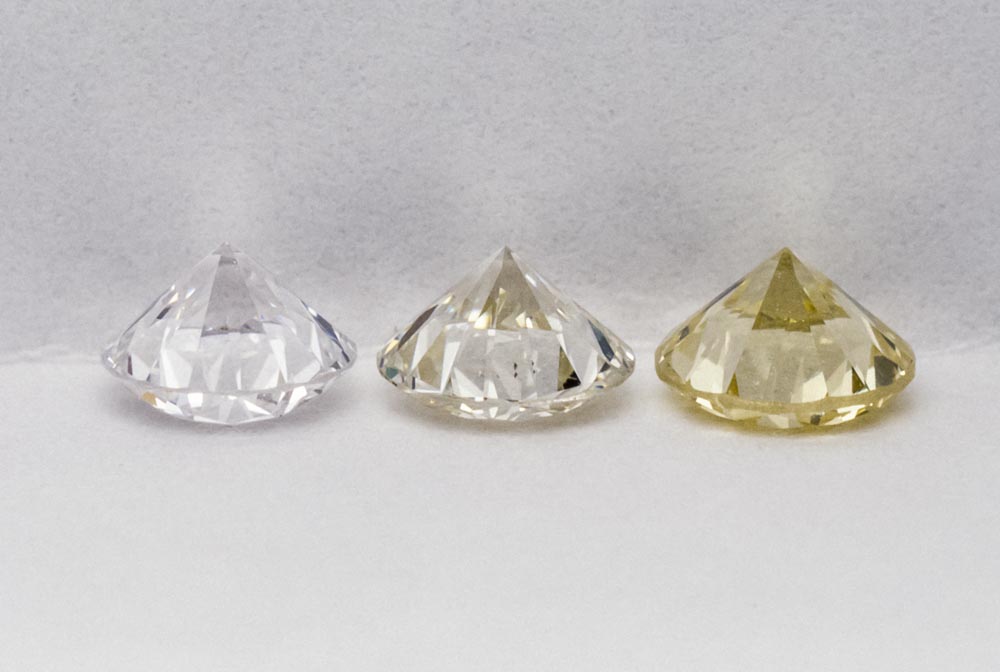
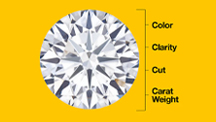
Color: The amount of a diamond's color, on a scale of D-to-Z
GIA’s D-to-Z scale measures the colorlessness of a diamond, comparing it to masterstones under controlled viewing conditions.

Clarity: The relative absence of inclusions and blemishes
Clarity grades are based on the number, size, relief, and positions of inclusions that can be seen under 10x magnification.

Cut: Can affect diamonds’ brilliance, fire, scintillation
Precise workmanship is required to cut a diamond so its proportions, symmetry, and polish maximize brightness, scintillation, and fire.

Carat Weight: Diamonds are sold by weight
One carat is equal to 0.20 grams. Only one in 1,000 diamonds weighs more than a carat.
DIAMOND QUALITY FACTORS: THE COMPREHENSIVE GUIDE
Tips & Advice
1. Insist on a diamond grading report.
The differences in diamond quality can be so subtle even a trained jeweler can't recognize them
without lab verification. Insist that any diamond you buy comes with an indisputable verification
of its quality from an unbiased source.
2. Protect your purchase.
Have your diamond appraised and insured. Appraisers and insurers rely on diamond grading
reports to accurately evaluate the value of gems. As an additional measure, consider having
your diamond laser-inscribed with its GIA report number, to provide verification if it is ever lost
or stolen.
3. Look for a gem that weighs a bit less than your target size.
Prices per carat generally increase as the weight passes “magic numbers” such as 1.00, 1.50,
and 2.00 carats. A diamond that weighs 0.95 carat will cost less per carat than a 1.00 carat
stone but look almost the same.
Questions & Answers
- Q
我如何获得 GIA 鉴定证书?
A您可将您的钻石送到 GIA 进行鉴定和分析。 很多消费者通过零售商进行钻石运送的包装、运输和保险事宜。 必须请珠宝商将钻石从镶座上取下,因为 GIA 只针对未镶嵌钻石出具钻石鉴定证书。
- Q
刻面数量更多的钻石是否更亮?
A刻面数量影响的是钻石的反射模式,而不是整体亮度。 刻面更多的钻石拥有较多的小刻面反射,而非较少的大刻面反射。 亮度是比例、磨光和对称所产生的效果,而不是刻面数量的效果。
- Q
我怎么才能确定钻石是无冲突钻石?
A2002 年,各国政府、非政府组织以及钻石行业联盟建立了金伯利进程,以控制钻石原石的出口和进口,从而消除冲突钻石的贸易。如今市场上 99% 的钻石都是无冲突钻石。
- Q
GIA 是否为钻石切工分级?
A是。 经过多年的广泛研究,GIA 钻石切工分级系统于 2005 年推出,将 D 到 Z 颜色等级范围内标准圆形明亮式钻石的整体切工质量评定为五个等级。
- Q
我如何确定 GIA 鉴定证书的真实性?
A为防止遗失或伪造,所有 GIA 证书均包含全息照片、安全界面和缩微相片等安全特征。 此外,GIA 证书检验服务还可以验证证书中的信息是否与我们数据库中的信息相匹配。
- Q
GIA 是否会为我的钻石估价?
- Q
GIA 是否提供实验室制造钻石的分级鉴定服务?
A是。自 2007 年以来,GIA 一直提供实验室制造钻石的鉴定服务。自 2019 年 7 月 1 日起,GIA 鉴定所出具的实验室制造钻石证书和鉴定证书不再使用“合成”一词。GIA 鉴定所出具的实验室制造钻石证书包括供参考的标准 GIA 颜色、净度和切工分级等级。证书使用描述性术语来说明颜色和净度。证书包含以下说明:这是一颗采用 CVD(化学蒸气沉淀法)或 HPHT(高压高温法)制造的人造钻石,可能包括后续处理,用以改变颜色。
Find out more
Caring for Your Diamond
Keep your diamond beautiful by following simple care and cleaning guidelines.
DURABILITY

CARE AND CLEANING
.jpg "YMAL GIA Ed")