
High-temperature heat treatment has long been the most widely used method for improving the color of corundum. Soon after Mozambique emerged as an important source of rubies in 2009, it was discovered that these stones reacted well to a lower-temperature heating process.
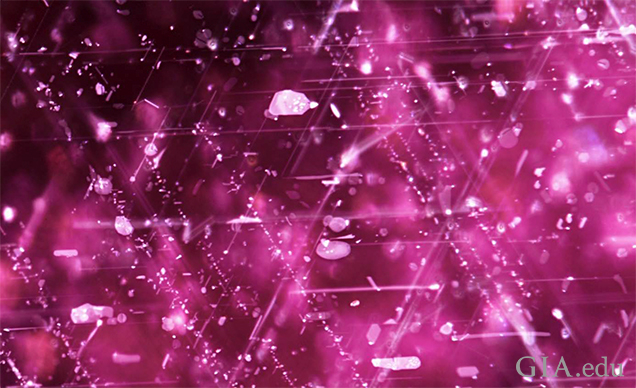
GIA's Bangkok laboratory recently performed heat treatment experiments on 47 Mozambican rubies mined in Mugloto (Montepuez area) and observed the changes that occurred after known conditions of temperature and duration. The results are available in a new study titled "Update on ‘Low-Temperature’ Heat Treatment of Mozambican Ruby: A Focus on Inclusions and FTIR Spectroscopy.”
The experiments showed that the blue component could be reduced at fairly low temperatures and improve the color to a purer red (changing from purplish red to red). While heat treatment is difficult to detect in Mozambican rubies, a combination of inclusion study and FTIR spectral analysis gave consistent and accurate results.
High-temperature heat treatment has long been the most widely used method for improving the color of corundum. Soon after Mozambique emerged as an important source of rubies in 2009, it was discovered that these stones reacted well to a lower-temperature heating process.
GIA's Bangkok laboratory recently performed heat treatment experiments on 47 Mozambican rubies mined in Mugloto (Montepuez area) and observed the changes that occurred after known conditions of temperature and duration. The results are available in a new study titled "Update on ‘Low-Temperature’ Heat Treatment of Mozambican Ruby: A Focus on Inclusions and FTIR Spectroscopy.”
The experiments showed that the blue component could be reduced at fairly low temperatures and improve the color to a purer red (changing from purplish red to red). While heat treatment is difficult to detect in Mozambican rubies, a combination of inclusion study and FTIR spectral analysis gave consistent and accurate results.
.jpg "YMAL GIA Ed")