
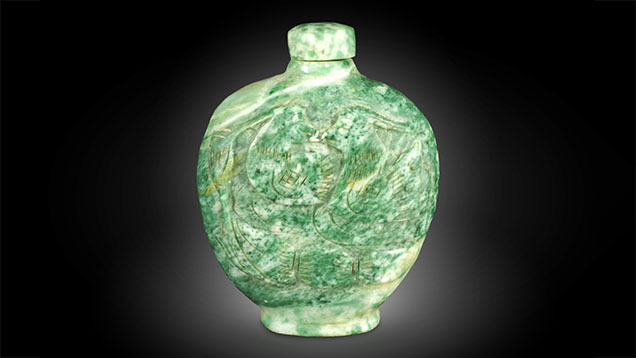
Recently, a carved green snuff bottle was submitted as jadeite jade for identification at the Taiwan Union Lab of Gem Research (TULAB) (figure 1). The surface of the bottle displayed a white matrix with dense mottled green areas. A spot refractive index was approximately 1.68–1.69, which was noticeably higher than the typical range of values for jadeite jade. However, such results may occur if jadeite contains kosmochlor.
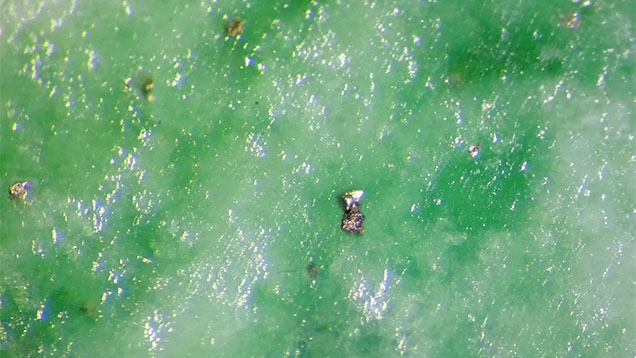
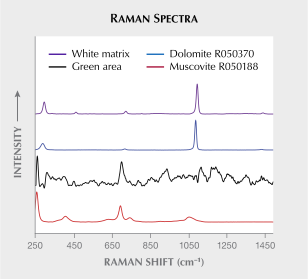
Under microscopic observation, the surface of the carving revealed a white matrix with green patches (figure 2). Interestingly, these green patches appeared red when viewed through a Chelsea filter. To further identify the material, Raman spectroscopy (785 nm laser) was performed and compared with the RRUFF database (B. Lafuente et al., 2015, https://rruff.info/about/downloads/HMC1-30.pdf). The results indicated that the white matrix was dolomite, while the dark green patches were muscovite (figure 3). With the assistance of energy-dispersive X-ray fluorescence (EDXRF) analysis, the green portions were confirmed to be fuchsite (chromium muscovite).
All testing indicated that the snuff bottle was composed of a dolomite aggregate with fuchsite. Although its appearance resembled jadeite jade, the bottle’s refractive index and Chelsea filter reaction clearly distinguished it from jadeite jade. Raman spectroscopy and EDXRF were used as more precise methods to confirm the material, which appears to be a new jadeite simulant that has recently appeared on the market.
Tsung-Ying Yang, Kai-Yun Huang, Yu-Shan Chou, and Shu-Hong Lin are affiliated with Taiwan Union Lab of Gem Research in Taipei.
Recently, a carved green snuff bottle was submitted as jadeite jade for identification at the Taiwan Union Lab of Gem Research (TULAB) (figure 1). The surface of the bottle displayed a white matrix with dense mottled green areas. A spot refractive index was approximately 1.68–1.69, which was noticeably higher than the typical range of values for jadeite jade. However, such results may occur if jadeite contains kosmochlor.
Under microscopic observation, the surface of the carving revealed a white matrix with green patches (figure 2). Interestingly, these green patches appeared red when viewed through a Chelsea filter. To further identify the material, Raman spectroscopy (785 nm laser) was performed and compared with the RRUFF database (B. Lafuente et al., 2015, https://rruff.info/about/downloads/HMC1-30.pdf). The results indicated that the white matrix was dolomite, while the dark green patches were muscovite (figure 3). With the assistance of energy-dispersive X-ray fluorescence (EDXRF) analysis, the green portions were confirmed to be fuchsite (chromium muscovite).
All testing indicated that the snuff bottle was composed of a dolomite aggregate with fuchsite. Although its appearance resembled jadeite jade, the bottle’s refractive index and Chelsea filter reaction clearly distinguished it from jadeite jade. Raman spectroscopy and EDXRF were used as more precise methods to confirm the material, which appears to be a new jadeite simulant that has recently appeared on the market.
Tsung-Ying Yang, Kai-Yun Huang, Yu-Shan Chou, and Shu-Hong Lin are affiliated with Taiwan Union Lab of Gem Research in Taipei.
.jpg "YMAL GIA Ed")