
Pen or pinna pearls, also known as the “fan clam,” originate from the marine bivalve mollusk belonging to the genus Pinna or Atrina. They are commonly found across the Indo-West Pacific region, from southeastern Africa to Melanesia and New Zealand, extending north to Japan and south to New South Wales. Additionally, they can be found in the Mediterranean Sea, the Red Sea, and the Arabian (Persian) Gulf. Typically, the shell size ranges from 10 to 60 cm, producing pearls measuring up to 11 mm and rarely even 16 mm. Most of these pearls are non-nacreous, displaying colors ranging from yellowish orange to brown and black, while the nacreous pearls exhibit a silvery surface (CIBJO Guide for Classifying Natural Pearls and Cultured Pearls, 2021).

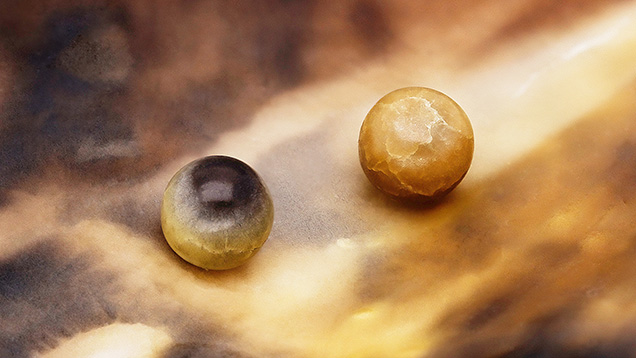
GIA’s Mumbai laboratory recently received two pen pearls for scientific examination. They were recovered by a renowned Bahraini diver from the shallow waters off Bahrain, fished at a depth of 2 meters in October 2023. Pearl A was a bicolor yellowish brown and black button shape, weighing 0.65 ct and measuring 4.65 × 4.25 mm, while pearl B was a yellowish brown near-button, weighing 0.73 ct and measuring 4.86 × 4.34 mm (figure 1). Visual observation showed significant surface-reaching cracks on pearl A (figure 2A) and a network of crazing or cracking due to the columnar structure on pearl B (figure 2C). When viewed under 40× magnification with a fiber-optic light, both exhibited a translucent non-nacreous surface with a columnar calcite structure, displaying a pseudo-hexagonal cellular outline (N. Sturman et al., “Observations on pearls reportedly from the Pinnidae family (pen pearls),” Fall 2014 G&G;, pp. 202–215).
The pearls showed an inert reaction when exposed to X-ray fluorescence. Energy-dispersive X-ray fluorescence spectrometry on both revealed manganese levels below detection limits and 45 ppm and higher strontium levels of 1183 ppm and 1303 ppm, respectively, confirming their saltwater origin. Under long-wave ultraviolet radiation, the black area on pearl A was inert, while the yellowish brown area showed a moderate yellowish green reaction similar to that of pearl B. Faint patchy reddish areas were also observed under the translucent surface of pearl B, a reaction linked to a type of porphyrin pigment. When exposed to short-wave UV, pearl A was almost inert and pearl B showed a weaker yellowish green reaction. When examined by the deep-UV wavelength (<230 nm) of the DiamondView, both revealed a greenish blue reaction with a mosaic of fine cellular features of the columnar calcite structure (figure 2, B and D).

Real-time X-ray microradiography (RTX) and X-ray computed microtomography (μ-CT) were conducted to study the internal structures. RTX imaging of pearl A revealed a fine acicular (radial) structure with significant surface-reaching cracks (figure 3A). A minute core was visible in μ-CT imaging (figure 3B). Pearl B also exhibited an acicular structure but with broader radiating lines than those observed in pearl A (figure 3C). Similarly, μ-CT imaging revealed a small central core with a few minor cracks (figure 3D). These structures corresponded with the columnar structure observed on their surfaces (Fall 2009 GNI, pp. 69–71).

Raman spectroscopy using 514 and 830 nm laser excitation revealed peaks for both pearls at 280 and 712 cm–1 as well as 1085 cm–1, indicative of calcite. The surface of pearl B was ground down, exposing a dark brown ring along with the acicular structure (figure 4, left). This ring was not visible in RTX or μ-CT imaging. Raman analysis on different spots of the ground pearl showed similar calcite peaks with a weak polyenic pigment peak at around 1437 cm–1. Photoluminescence analysis for both pearls revealed very weak bands at 620, 650, and 680 nm, indicating natural coloration. These bands were more distinct on the cross-sectional areas of pearl B. In addition, the dark brown central core and ring exhibited a brownish red reaction when viewed under long-wave UV radiation (figure 4, right), linked to a type of porphyrin pigment previously recorded in partially non-nacreous and nacreous pearls from the Pteria species (S. Karampelas and H. Abdulla, “Black non-nacreous natural pearls from Pteria sp.,” Journal of Gemmology, Vol. 35, No. 7, 2017, pp. 590–592) and in a Pinctada radiata shell with a partially non-nacreous blister pearl (Winter 2023 GNI, pp. 527–529).
Non-nacreous pen pearls are often priced lower than their nacreous counterparts from the Pinctada species, mainly due to their durability issues related to surface cracks. Although not desirable for jewelry purposes, they have been used as nuclei for producing atypical bead cultured pearls. In such cases, identification becomes very challenging due to their internal structure composed of natural acicular growth features. This submission provided an interesting opportunity to study these known pen pearl samples from Bahrain, a habitat shared with the popular Pinctada radiata mollusk species.
Pen or pinna pearls, also known as the “fan clam,” originate from the marine bivalve mollusk belonging to the genus Pinna or Atrina. They are commonly found across the Indo-West Pacific region, from southeastern Africa to Melanesia and New Zealand, extending north to Japan and south to New South Wales. Additionally, they can be found in the Mediterranean Sea, the Red Sea, and the Arabian (Persian) Gulf. Typically, the shell size ranges from 10 to 60 cm, producing pearls measuring up to 11 mm and rarely even 16 mm. Most of these pearls are non-nacreous, displaying colors ranging from yellowish orange to brown and black, while the nacreous pearls exhibit a silvery surface (CIBJO Guide for Classifying Natural Pearls and Cultured Pearls, 2021).
GIA’s Mumbai laboratory recently received two pen pearls for scientific examination. They were recovered by a renowned Bahraini diver from the shallow waters off Bahrain, fished at a depth of 2 meters in October 2023. Pearl A was a bicolor yellowish brown and black button shape, weighing 0.65 ct and measuring 4.65 × 4.25 mm, while pearl B was a yellowish brown near-button, weighing 0.73 ct and measuring 4.86 × 4.34 mm (figure 1). Visual observation showed significant surface-reaching cracks on pearl A (figure 2A) and a network of crazing or cracking due to the columnar structure on pearl B (figure 2C). When viewed under 40× magnification with a fiber-optic light, both exhibited a translucent non-nacreous surface with a columnar calcite structure, displaying a pseudo-hexagonal cellular outline (N. Sturman et al., “Observations on pearls reportedly from the Pinnidae family (pen pearls),” Fall 2014 G&G;, pp. 202–215).
The pearls showed an inert reaction when exposed to X-ray fluorescence. Energy-dispersive X-ray fluorescence spectrometry on both revealed manganese levels below detection limits and 45 ppm and higher strontium levels of 1183 ppm and 1303 ppm, respectively, confirming their saltwater origin. Under long-wave ultraviolet radiation, the black area on pearl A was inert, while the yellowish brown area showed a moderate yellowish green reaction similar to that of pearl B. Faint patchy reddish areas were also observed under the translucent surface of pearl B, a reaction linked to a type of porphyrin pigment. When exposed to short-wave UV, pearl A was almost inert and pearl B showed a weaker yellowish green reaction. When examined by the deep-UV wavelength (<230 nm) of the DiamondView, both revealed a greenish blue reaction with a mosaic of fine cellular features of the columnar calcite structure (figure 2, B and D).
Real-time X-ray microradiography (RTX) and X-ray computed microtomography (μ-CT) were conducted to study the internal structures. RTX imaging of pearl A revealed a fine acicular (radial) structure with significant surface-reaching cracks (figure 3A). A minute core was visible in μ-CT imaging (figure 3B). Pearl B also exhibited an acicular structure but with broader radiating lines than those observed in pearl A (figure 3C). Similarly, μ-CT imaging revealed a small central core with a few minor cracks (figure 3D). These structures corresponded with the columnar structure observed on their surfaces (Fall 2009 GNI, pp. 69–71).
Raman spectroscopy using 514 and 830 nm laser excitation revealed peaks for both pearls at 280 and 712 cm–1 as well as 1085 cm–1, indicative of calcite. The surface of pearl B was ground down, exposing a dark brown ring along with the acicular structure (figure 4, left). This ring was not visible in RTX or μ-CT imaging. Raman analysis on different spots of the ground pearl showed similar calcite peaks with a weak polyenic pigment peak at around 1437 cm–1. Photoluminescence analysis for both pearls revealed very weak bands at 620, 650, and 680 nm, indicating natural coloration. These bands were more distinct on the cross-sectional areas of pearl B. In addition, the dark brown central core and ring exhibited a brownish red reaction when viewed under long-wave UV radiation (figure 4, right), linked to a type of porphyrin pigment previously recorded in partially non-nacreous and nacreous pearls from the Pteria species (S. Karampelas and H. Abdulla, “Black non-nacreous natural pearls from Pteria sp.,” Journal of Gemmology, Vol. 35, No. 7, 2017, pp. 590–592) and in a Pinctada radiata shell with a partially non-nacreous blister pearl (Winter 2023 GNI, pp. 527–529).
Non-nacreous pen pearls are often priced lower than their nacreous counterparts from the Pinctada species, mainly due to their durability issues related to surface cracks. Although not desirable for jewelry purposes, they have been used as nuclei for producing atypical bead cultured pearls. In such cases, identification becomes very challenging due to their internal structure composed of natural acicular growth features. This submission provided an interesting opportunity to study these known pen pearl samples from Bahrain, a habitat shared with the popular Pinctada radiata mollusk species.