

For centuries, pearls have been one of the most imitated gems. Traditionally created by coating spherical glass beads with pearlescent paint, these imitations were designed to resemble the color, luster, and heft of genuine pearls. This continued with the advent of plastic beads and, more recently, coated shell beads (Summer 2014 Lab Notes, pp. 153–154). A new simulant has since been gaining popularity in the fashion jewelry market: “cotton pearls” (figure 1).
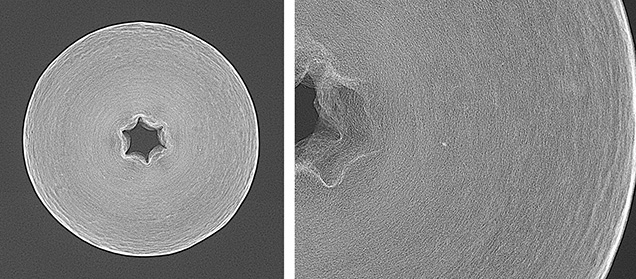

Cotton pearls are available in a variety of colors and sizes, allowing them to imitate nearly every pearl species. These beads are created from cotton fibers or other fibrous textile materials that are tightly packed and concentrically layered. Their internal structure can be revealed by real-time X-ray microradiography (RTX), as shown in figure 2. The image displays concentric bands composed of fine fibers as well as a bright white edge representing the higher-density coating on the bead’s exterior. The star-shaped “drill hole” is likely a remnant of the manufacturing process rather than an actual drill hole. It is possibly in the shape of the spindle on which the fibers are rotated, creating concentric layering. To examine the interior, a bead was cut in half perpendicular to the “drill hole.” This exposed tightly packed white fibers throughout with faint concentric layering (figure 3), consistent with observations from the RTX images.
Cotton pearls are lightweight and comfortable to wear, particularly compared to glass or shell imitations of large pearls such as South Sea or Tahitian. They are also surprisingly strong and did not deform when pressed firmly between the fingers. Additionally, the textured surface of cotton pearls gives them a convincing visual impression.
If imitation is the sincerest form of flattery, then pearls certainly continue to inspire admiration and innovation.
For centuries, pearls have been one of the most imitated gems. Traditionally created by coating spherical glass beads with pearlescent paint, these imitations were designed to resemble the color, luster, and heft of genuine pearls. This continued with the advent of plastic beads and, more recently, coated shell beads (Summer 2014 Lab Notes, pp. 153–154). A new simulant has since been gaining popularity in the fashion jewelry market: “cotton pearls” (figure 1).
Cotton pearls are available in a variety of colors and sizes, allowing them to imitate nearly every pearl species. These beads are created from cotton fibers or other fibrous textile materials that are tightly packed and concentrically layered. Their internal structure can be revealed by real-time X-ray microradiography (RTX), as shown in figure 2. The image displays concentric bands composed of fine fibers as well as a bright white edge representing the higher-density coating on the bead’s exterior. The star-shaped “drill hole” is likely a remnant of the manufacturing process rather than an actual drill hole. It is possibly in the shape of the spindle on which the fibers are rotated, creating concentric layering. To examine the interior, a bead was cut in half perpendicular to the “drill hole.” This exposed tightly packed white fibers throughout with faint concentric layering (figure 3), consistent with observations from the RTX images.
Cotton pearls are lightweight and comfortable to wear, particularly compared to glass or shell imitations of large pearls such as South Sea or Tahitian. They are also surprisingly strong and did not deform when pressed firmly between the fingers. Additionally, the textured surface of cotton pearls gives them a convincing visual impression.
If imitation is the sincerest form of flattery, then pearls certainly continue to inspire admiration and innovation.