
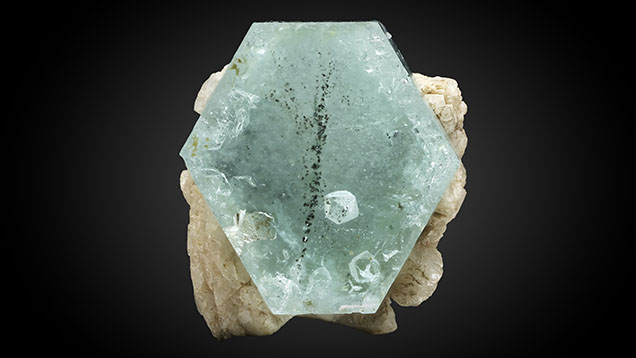
The specimen shown in figure 1, weighing 80.60 ct and measuring approximately 28 × 24 × 22 mm, consists of a sharp, well-formed aquamarine beryl crystal grown on microcline feldspar crystals. The sample is from Pakistan’s Shigar Valley in the Skardu district of Gilgit-Baltistan.

Microscopic examination revealed a single, sharply defined inclusion approximately 3 mm in length (figure 2). The strikingly short bipyramidal morphology is characteristic of β-quartz, the high-temperature polymorph of silicon dioxide, which usually transitions to α-quartz upon cooling below ~570°C (W.L. Bragg and R.E. Gibbs, “The structure of α and β quartz,” Proceedings of the Royal Society of London. Series A, Vol. 109, No. 751, 1925, pp. 405–427). That transition typically destroys the original crystal shape, making preserved β-quartz morphology exceedingly rare in nature.
In this case, it appears that rapid encapsulation within the growing beryl may have frozen the morphology in place before the reconstructive transition could alter the form. While the inclusion is α-quartz in structure today, as confirmed by Raman spectroscopy, its preserved β-quartz–like shape raises intriguing questions about formation conditions and cooling rates. A literature search failed to reveal any other examples of the β-quartz form preserved within beryl.
Russell E. Behnke is a mineral dealer in Meriden, Connecticut.
The specimen shown in figure 1, weighing 80.60 ct and measuring approximately 28 × 24 × 22 mm, consists of a sharp, well-formed aquamarine beryl crystal grown on microcline feldspar crystals. The sample is from Pakistan’s Shigar Valley in the Skardu district of Gilgit-Baltistan.
Microscopic examination revealed a single, sharply defined inclusion approximately 3 mm in length (figure 2). The strikingly short bipyramidal morphology is characteristic of β-quartz, the high-temperature polymorph of silicon dioxide, which usually transitions to α-quartz upon cooling below ~570°C (W.L. Bragg and R.E. Gibbs, “The structure of α and β quartz,” Proceedings of the Royal Society of London. Series A, Vol. 109, No. 751, 1925, pp. 405–427). That transition typically destroys the original crystal shape, making preserved β-quartz morphology exceedingly rare in nature.
In this case, it appears that rapid encapsulation within the growing beryl may have frozen the morphology in place before the reconstructive transition could alter the form. While the inclusion is α-quartz in structure today, as confirmed by Raman spectroscopy, its preserved β-quartz–like shape raises intriguing questions about formation conditions and cooling rates. A literature search failed to reveal any other examples of the β-quartz form preserved within beryl.
Russell E. Behnke is a mineral dealer in Meriden, Connecticut.
.jpg "YMAL GIA Ed")