
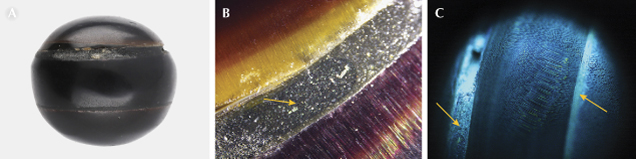
GIA’s Mumbai laboratory recently examined an undrilled black near-round bead, weighing 10.56 ct and measuring 12.23 × 11.87 × 10.78 mm, submitted for identification (figure 1A). Initial examination of the specimen indicated that it was an assembled imitation pearl made from shell fragments.
Visually, the specimen consisted of three distinct sections fused together using a dark-colored bonding agent. Under high magnification, some areas revealed columnar structures similar to those observed in non-nacreous pen pearls from the Pinnidae family. Fine lines from working and polishing the specimen were visible across the surface, likely created during the shaping process. Interestingly, under fiber-optic illumination, a chatoyancy-like phenomenon was created by the fine acicular structure of calcite crystals of the shell (figure 1B). When examined using the deep-UV wavelength (<230 nm) of the DiamondView, the three fragments exhibited prominent bands with a bluish reaction and fine cellular hexagonal calcitic columnar features typical of a pen shell (figure 1C; Spring 2017 G&G Micro-World, pp. 105–106). The bonding agent displayed a stronger bluish green reaction.
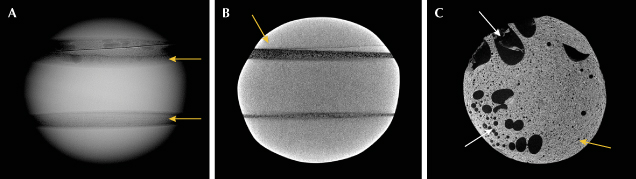
The specimen showed an inert reaction under X-ray fluorescence. Energy-dispersive X-ray fluorescence analysis conducted on the three fragments revealed no traces of manganese but strontium levels of 639, 819, and 904 ppm, respectively, indicating that they were of saltwater origin. Real-time X-ray microradiography (RTX) displayed a distinct banding pattern wherein demarcations were visible between the shell fragments and the bonding agent (figure 2A). The shell fragments exhibited a tight structure. X-ray computed microtomography (μ-CT) imaging showed a more defined banding structure and gas bubbles trapped within the bonding agent (figure 2, B and C). All these characteristics were similar to those previously observed in imitation pearls made of pen shell (Fall 2019 Gem News International, pp. 445–446).
Collectively, the analytical data and observations indicated that the three fragments originated from the same kind of shell, possibly pen shell, and were bonded to create an imitation resembling a whole non-nacreous pen pearl.
Keaton Talker is an analytics technician, and Roxane Bhot Jain is manager of pearl, melee, and AGSI technical and market development, at GIA in Mumbai. Abeer Al-Alawi is a consultant to GIA.
GIA’s Mumbai laboratory recently examined an undrilled black near-round bead, weighing 10.56 ct and measuring 12.23 × 11.87 × 10.78 mm, submitted for identification (figure 1A). Initial examination of the specimen indicated that it was an assembled imitation pearl made from shell fragments.
Visually, the specimen consisted of three distinct sections fused together using a dark-colored bonding agent. Under high magnification, some areas revealed columnar structures similar to those observed in non-nacreous pen pearls from the Pinnidae family. Fine lines from working and polishing the specimen were visible across the surface, likely created during the shaping process. Interestingly, under fiber-optic illumination, a chatoyancy-like phenomenon was created by the fine acicular structure of calcite crystals of the shell (figure 1B). When examined using the deep-UV wavelength (<230 nm) of the DiamondView, the three fragments exhibited prominent bands with a bluish reaction and fine cellular hexagonal calcitic columnar features typical of a pen shell (figure 1C; Spring 2017 G&G Micro-World, pp. 105–106). The bonding agent displayed a stronger bluish green reaction.
The specimen showed an inert reaction under X-ray fluorescence. Energy-dispersive X-ray fluorescence analysis conducted on the three fragments revealed no traces of manganese but strontium levels of 639, 819, and 904 ppm, respectively, indicating that they were of saltwater origin. Real-time X-ray microradiography (RTX) displayed a distinct banding pattern wherein demarcations were visible between the shell fragments and the bonding agent (figure 2A). The shell fragments exhibited a tight structure. X-ray computed microtomography (μ-CT) imaging showed a more defined banding structure and gas bubbles trapped within the bonding agent (figure 2, B and C). All these characteristics were similar to those previously observed in imitation pearls made of pen shell (Fall 2019 Gem News International, pp. 445–446).
Collectively, the analytical data and observations indicated that the three fragments originated from the same kind of shell, possibly pen shell, and were bonded to create an imitation resembling a whole non-nacreous pen pearl.
Keaton Talker is an analytics technician, and Roxane Bhot Jain is manager of pearl, melee, and AGSI technical and market development, at GIA in Mumbai. Abeer Al-Alawi is a consultant to GIA.
.jpg "YMAL GIA Ed")