
Here at the end we are left with the question “What’s next?” Geographic origin determination is likely here to stay. In fact, like it or not, it may expand to other gemstones. As to which gemstones that will be, it depends entirely on whether or not there is a demand for this service. The reason? It takes a lot of time, effort, and expense to develop criteria for any gemstone, but if there is a significant demand for it, there is reason to pursue it.
Take demantoid garnet as an example. It is a small market because of availability, but there is a demand for demantoid from Russia versus other deposits, and there are not that many deposits known in the world. Therefore, this is a reasonable service to offer. Some laboratories already do.
On the other hand, we have occasionally been asked if we could do geographic origin on amethyst. Whether amethyst carries enough value to justify the expense is not for the laboratories to say. However, amethyst comes from so many locations around the world that the cost of developing such a service would be prohibitive in relation to the market value of amethyst. It is also quite likely that for this same reason the overlap of properties would be so severe as to make separation impossible.
CAN WE IMPROVE THIS SERVICE?
Since geographic origin is here to stay, one of our primary focuses should be to improve how it’s done. It is safe to say that everyone involved would like nothing more than to make it less of an opinion and improve the overall consistency.
How do we do that? The most significant way is to pursue advances in technology or to try to adapt technologies that have been developed for other industries. Some examples of techniques that are currently being researched for gemstone applications are:
- Isotopic analysis
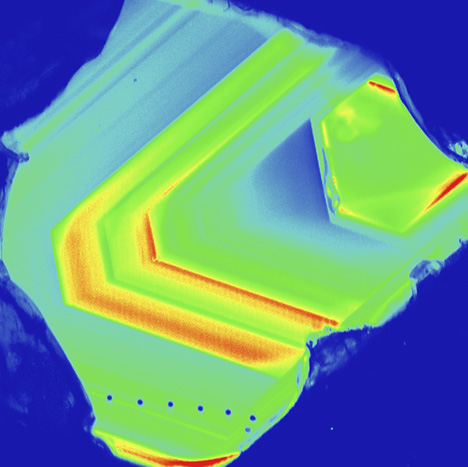
- Ultraviolet fluorescence mapping
- Ultraviolet fluorescence spectroscopy
- Raman mapping
- Photoluminescence spectroscopy
- Cathodoluminescence spectroscopy
It is important to note that adapting instrumentation to work with gemstones is usually not easy. Sample holders might need to be designed and built, sample chambers might need to be modified, and different procedures might need to be developed, all because we might be attempting to use an instrument in a way it was not originally designed for.
None of these instruments were developed with valuable, relatively fragile test subjects in mind. When scientists in other fields want to test a sample, they are usually not concerned about the worth of that sample. Typically the samples they use have little intrinsic value. If an X-ray powder diffraction analysis is needed, a piece of the sample may be ground to dust and that powder used for analysis. Obviously this won’t work for faceted gemstones. To solve this problem, one of GIA’s famous gemologists of the past, Charles Fryer, developed a technique that used a scraper made of a diamond mounted on a brass rod that was used to remove a microscopic amount of material from the girdle of a faceted stone. This powder was mounted on a tiny glass fiber to obtain a diffraction pattern with no weight loss and no eye-visible damage to the stone. The advent of Raman spectroscopy made this technique almost obsolete.
Progress also defines new and ever challenging limitations in analysis. The typical instrument for chemical analysis of gemstones prior to about 2003 was EDXRF (energy-dispersive X-ray fluorescence spectroscopy). While it is a good technique that is completely nondestructive and more of a bulk sampling method, which is a plus in many cases, it cannot detect elements lighter than sodium on the periodic table, it is difficult to achieve truly quantitative results, and it typically has much higher detection limits than mass spectrometry techniques.
In 2003, when the beryllium treatment of sapphire was finally understood, the need for chemical analysis of lighter elements at low concentrations became necessary. The technique called LA-ICP-MS (laser ablation–inductively coupled plasma–mass spectrometry) allows true quantitative analysis of almost all the elements on the periodic table at very low concentrations. The drawbacks: The instrument is expensive to buy and maintain. It takes skilled personnel to operate and maintain it and to correctly analyze the data that come from it. Also, it is a micro-sampling technique that only analyzes material from a small spot on the stone, so multiple spots are necessary to get an accurate picture of a stone’s chemistry.
Accurate, repeatable data for such a machine highly depends on the standards one uses. Poor standards will produce poor results. GIA felt it necessary to produce in-house corundum standards for testing rubies and sapphires since a great many of these stones are tested in the laboratory. These standards did not exist previously and took a great deal of time and expense to create.
This is just one example of the problems faced by gemological researchers. Sometimes there just isn’t any information available on a given subject. When beryllium was discovered as a treatment in corundum, it quickly became clear that almost no data existed concerning this element in this material. Everything we know today had to be collected and analyzed subsequent to the advent of this treatment.
How do we know or learn about techniques or instrumentation that might be out there somewhere waiting to be discovered? We go outside the usual gemological sources and try to connect with bright young students, and universities and other institutions that are performing research that might cross over to our needs. To this end, GIA has an active postdoctoral program and an internship program in which we hope to find young talent with fresh ideas who might be interested in the world of gemstones. We also reach out and work with well-established geologists, mineralogists, physicists, and others in major institutions such as Caltech, the Smithsonian Institution, the Carnegie Institution, and universities in Louisiana, Wisconsin, and elsewhere.
TIMES ARE CHANGING
The whole concept and need for geographic origin determination of colored stones has until recently been largely focused on the monetary value of a gemstone based on its provenance. This has been the case for a long time.
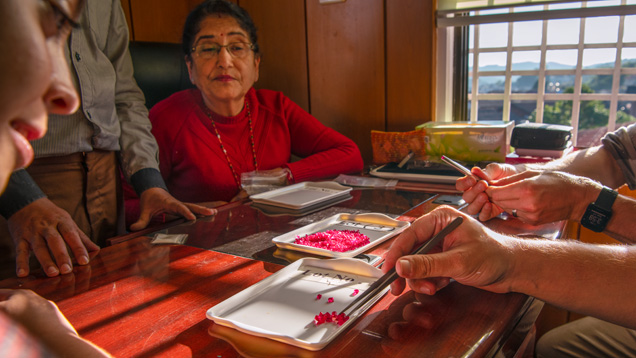
However, we are forced to recognize that the use of this kind of information is no longer limited to value alone. It cannot be denied that geographic origin has become important in other ways. In 2019 the United States government stated that they are watching the jewelry industry and considering passing regulations that will require jewelers to have knowledge of where the materials they sell originated. This is not because they are concerned about the value of stones being sold. They are concerned about terrorism and money laundering. It may soon be required that all jewelers have documentation declaring the source of their gemstones and precious metals.
The other concern is that the millennial generation—the young adults of the world—are less concerned with value and “sparkle” than with the social and economic impact of what they buy. Is it ethical, is it sustainable, is it damaging to the environment, is child labor being used to produce it? These and other questions are important to them. The jewelry industry needs to pay attention, and geographic origin determination will play a significant role in providing some answers.
Finally, we should ask ourselves if geographic origin and all the other services and information the industry provides the jewelry-buying public are really in the public’s best interest. This is a difficult but important question to answer. GIA’s mission is to ensure the public trust in gems and jewelry, and we firmly believe that it is necessary to continually ask ourselves if what we do is in the best interest of the public. We also must reconcile industry wishes with the limitations of science in determining the geographic origin of a gemstone.
Here at the end we are left with the question “What’s next?” Geographic origin determination is likely here to stay. In fact, like it or not, it may expand to other gemstones. As to which gemstones that will be, it depends entirely on whether or not there is a demand for this service. The reason? It takes a lot of time, effort, and expense to develop criteria for any gemstone, but if there is a significant demand for it, there is reason to pursue it.
Take demantoid garnet as an example. It is a small market because of availability, but there is a demand for demantoid from Russia versus other deposits, and there are not that many deposits known in the world. Therefore, this is a reasonable service to offer. Some laboratories already do.
On the other hand, we have occasionally been asked if we could do geographic origin on amethyst. Whether amethyst carries enough value to justify the expense is not for the laboratories to say. However, amethyst comes from so many locations around the world that the cost of developing such a service would be prohibitive in relation to the market value of amethyst. It is also quite likely that for this same reason the overlap of properties would be so severe as to make separation impossible.
.jpg "YMAL GIA Ed")