
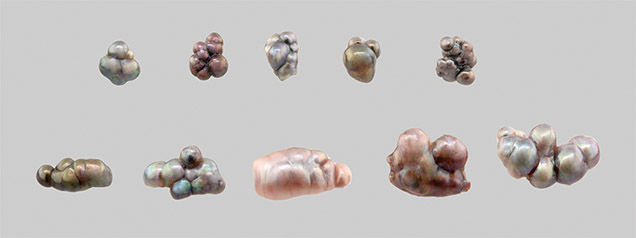
Both natural and cultured pearls of Pteria -species mollusks from the Gulf of California, Mexico (M. Cariño and M. Monteforte, “ History of pearling in La Paz Bay, South Baja California ,” Summer 1995 G&G , pp. 88–104; L. Kiefert et al., “ Cultured pearls from the Gulf of California, Mexico ,” Spring 2004 G&G , pp. 26–38) are examined in GIA laboratories from time to time. But a recent submission to the New York lab of 10 loose pearls, ranging from 8.17 × 7.65 × 3.89 mm to 17.85 × 11.16 × 6.80 mm (figure 1), proved interesting owing to their shapes and internal growth features. All the pearls had a “grapelike” cluster appearance, as if multiple smaller pearls had combined into aggregates. Their colors ranged from dark brown and purple to gray, with strong orient consisting of mainly bluish and pinkish overtones.
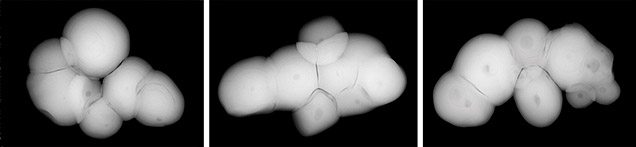
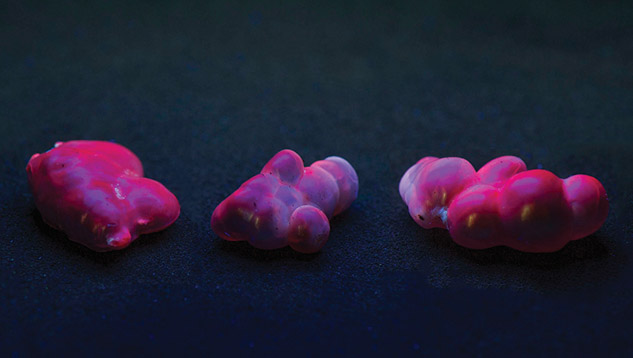
Microscopic examination revealed that the pearls formed with continuous nacre layers. Microradiography further demonstrated that their internal structures were composed of multiple small pearls related to their growth (figure 2). Conchiolin-rich centers were observed in all of the sub-units, indicating natural formation. Additional advanced testing (UV-Vis reflectance spectrophotometry, photoluminescence spectroscopy, and EDXRF spectrometry) showed that all 10 of the pearls had a natural color. More importantly, all 10 exhibited medium to strong orangy red to red fluorescence under long-wave UV, which is characteristic of pearls that form in Pteria mollusks (figure 3).
Pearls grown from the aggregation of smaller pearls are sometimes associated with freshwater culturing practices (Summer 2012 Lab Notes, pp. 138–139). Yet these samples clearly did not appear to be cultured. Our client later informed us that the pearls were obtained more than 40 years ago, reportedly off the Mexican coast, which further supports the identity of these unique pieces.
Both natural and cultured pearls of Pteria -species mollusks from the Gulf of California, Mexico (M. Cariño and M. Monteforte, “ History of pearling in La Paz Bay, South Baja California ,” Summer 1995 G&G , pp. 88–104; L. Kiefert et al., “ Cultured pearls from the Gulf of California, Mexico ,” Spring 2004 G&G , pp. 26–38) are examined in GIA laboratories from time to time. But a recent submission to the New York lab of 10 loose pearls, ranging from 8.17 × 7.65 × 3.89 mm to 17.85 × 11.16 × 6.80 mm (figure 1), proved interesting owing to their shapes and internal growth features. All the pearls had a “grapelike” cluster appearance, as if multiple smaller pearls had combined into aggregates. Their colors ranged from dark brown and purple to gray, with strong orient consisting of mainly bluish and pinkish overtones.
Microscopic examination revealed that the pearls formed with continuous nacre layers. Microradiography further demonstrated that their internal structures were composed of multiple small pearls related to their growth (figure 2). Conchiolin-rich centers were observed in all of the sub-units, indicating natural formation. Additional advanced testing (UV-Vis reflectance spectrophotometry, photoluminescence spectroscopy, and EDXRF spectrometry) showed that all 10 of the pearls had a natural color. More importantly, all 10 exhibited medium to strong orangy red to red fluorescence under long-wave UV, which is characteristic of pearls that form in Pteria mollusks (figure 3).
Pearls grown from the aggregation of smaller pearls are sometimes associated with freshwater culturing practices (Summer 2012 Lab Notes, pp. 138–139). Yet these samples clearly did not appear to be cultured. Our client later informed us that the pearls were obtained more than 40 years ago, reportedly off the Mexican coast, which further supports the identity of these unique pieces.
.jpg "YMAL GIA Ed")