
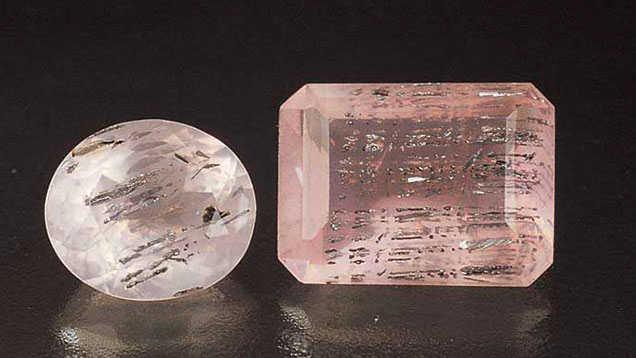
Eye-visible inclusions are common in almost all quartz varieties except rose quartz. Although massive rose quartz is colored by submicroscopic inclusions (see J. S. Goreva et al., “Fibrous nanoinclusions in massive rose quartz: The origin of rose coloration,” American Mineralogist, Vol. 86, No. 4, 2001, pp. 466–472), only very rarely does this material contain macroscopic inclusions (see, e.g., Summer 2003 Gem News International, pp. 159–162). At the 2005 Tucson gem shows, one of these contributors (FD) had some unusual rose quartz from Madagascar that displayed abundant, conspicuous inclusions with a metallic luster (figure 12).
The material was recovered from the Itongafeno pegmatite (also known as Tsaramanga), located 23 km west of Antsirabe near the village of Mahaiza. This deposit is part of the Analalava pegmatite district and has been worked for asteriated rose quartz and dark blue aquamarine for almost 100 years. In addition to common pegmatite minerals, it has produced rare examples of emerald and native bismuth. Several vertically disposed zones of mineralization have been identified in the pegmatite, including rose quartz, smoky quartz adjacent to a thin Nb-Ta oxide and biotite layer, and rose quartz with metallic inclusions. About 60 kg of the included rose quartz was extracted between September 2003 and June 2004, although only a small percentage was suitable for cutting.
The material was recovered from the Itongafeno pegmatite (also known as Tsaramanga), located 23 km west of Antsirabe near the village of Mahaiza. This deposit is part of the Analalava pegmatite district and has been worked for asteriated rose quartz and dark blue aquamarine for almost 100 years. In addition to common pegmatite minerals, it has produced rare examples of emerald and native bismuth. Several vertically disposed zones of mineralization have been identified in the pegmatite, including rose quartz, smoky quartz adjacent to a thin Nb-Ta oxide and biotite layer, and rose quartz with metallic inclusions. About 60 kg of the included rose quartz was extracted between September 2003 and June 2004, although only a small percentage was suitable for cutting.
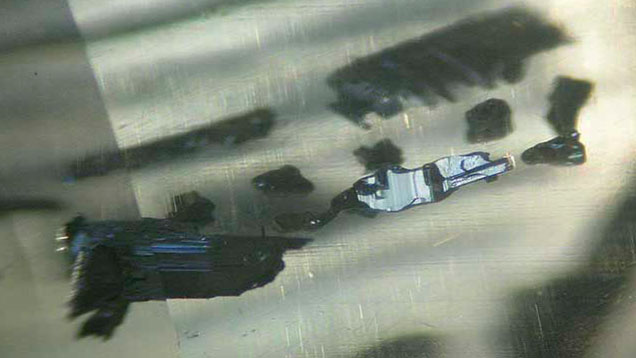
In addition to the inclusions described above, the rose quartz also contained abundant tiny colorless needles possibly rutile; again, see figure 13) oriented in three directions at angles of 120°. These needles are apparently the cause of asterism in samples that are cut as spheres or cabochons.
To our knowledge, this is the first confirmed report of bismuthinite in faceted quartz from a pegmatite. Previously, bismuthinite was identified in quartz from tintungsten deposits and from Alpine-type fissures (see J. Hyrsl and G. Niedermayr, Magic World: Inclusions in Quartz, Bode Verlag, Haltern, Germany, 2003, p. 48).
Eye-visible inclusions are common in almost all quartz varieties except rose quartz. Although massive rose quartz is colored by submicroscopic inclusions (see J. S. Goreva et al., “Fibrous nanoinclusions in massive rose quartz: The origin of rose coloration,” American Mineralogist, Vol. 86, No. 4, 2001, pp. 466–472), only very rarely does this material contain macroscopic inclusions (see, e.g., Summer 2003 Gem News International, pp. 159–162). At the 2005 Tucson gem shows, one of these contributors (FD) had some unusual rose quartz from Madagascar that displayed abundant, conspicuous inclusions with a metallic luster (figure 12).
The material was recovered from the Itongafeno pegmatite (also known as Tsaramanga), located 23 km west of Antsirabe near the village of Mahaiza. This deposit is part of the Analalava pegmatite district and has been worked for asteriated rose quartz and dark blue aquamarine for almost 100 years. In addition to common pegmatite minerals, it has produced rare examples of emerald and native bismuth. Several vertically disposed zones of mineralization have been identified in the pegmatite, including rose quartz, smoky quartz adjacent to a thin Nb-Ta oxide and biotite layer, and rose quartz with metallic inclusions. About 60 kg of the included rose quartz was extracted between September 2003 and June 2004, although only a small percentage was suitable for cutting.
The material was recovered from the Itongafeno pegmatite (also known as Tsaramanga), located 23 km west of Antsirabe near the village of Mahaiza. This deposit is part of the Analalava pegmatite district and has been worked for asteriated rose quartz and dark blue aquamarine for almost 100 years. In addition to common pegmatite minerals, it has produced rare examples of emerald and native bismuth. Several vertically disposed zones of mineralization have been identified in the pegmatite, including rose quartz, smoky quartz adjacent to a thin Nb-Ta oxide and biotite layer, and rose quartz with metallic inclusions. About 60 kg of the included rose quartz was extracted between September 2003 and June 2004, although only a small percentage was suitable for cutting.
In addition to the inclusions described above, the rose quartz also contained abundant tiny colorless needles possibly rutile; again, see figure 13) oriented in three directions at angles of 120°. These needles are apparently the cause of asterism in samples that are cut as spheres or cabochons.
To our knowledge, this is the first confirmed report of bismuthinite in faceted quartz from a pegmatite. Previously, bismuthinite was identified in quartz from tintungsten deposits and from Alpine-type fissures (see J. Hyrsl and G. Niedermayr, Magic World: Inclusions in Quartz, Bode Verlag, Haltern, Germany, 2003, p. 48).
.jpg "YMAL GIA Ed")