
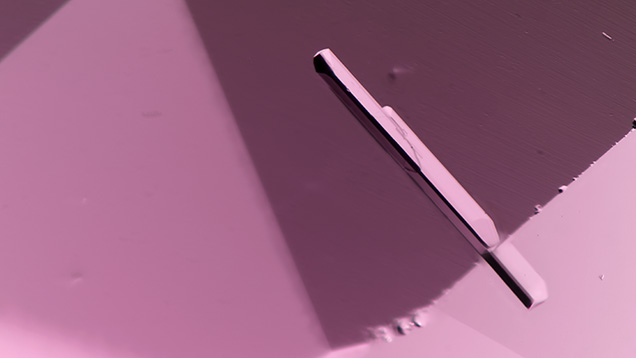
A 1.33 ct pink spinel containing a distinct mineral inclusion located near the stone’s surface was recently examined by the author. Raman analysis identified the inclusion as a pargasite (NaCa2(Mg4Al)(Si6Al2)O22(OH)2) crystal. This euhedral prismatic crystal displayed chamfered terminations, rhombohedral pinacoids, and a near-colorless bodycolor (see above). Reflected light highlighted a central feature, possibly a growth hillock, which gave the appearance of two connected pargasite crystals. While pargasite inclusions are more commonly found in corundum than in spinel, few have been documented exhibiting such remarkable morphology.
Hannah Wiggins is a staff gemologist at GIA in New York.
A 1.33 ct pink spinel containing a distinct mineral inclusion located near the stone’s surface was recently examined by the author. Raman analysis identified the inclusion as a pargasite (NaCa2(Mg4Al)(Si6Al2)O22(OH)2) crystal. This euhedral prismatic crystal displayed chamfered terminations, rhombohedral pinacoids, and a near-colorless bodycolor (see above). Reflected light highlighted a central feature, possibly a growth hillock, which gave the appearance of two connected pargasite crystals. While pargasite inclusions are more commonly found in corundum than in spinel, few have been documented exhibiting such remarkable morphology.
Hannah Wiggins is a staff gemologist at GIA in New York.
.jpg "YMAL GIA Ed")