
The basic shape of a rough diamond is all around us, from black diamonds on ski slopes to the familiar red diamonds in a standard deck of playing cards. These symbols are the silhouette of an octahedron, which is the archetypal diamond crystal. Indeed, the octahedron appears regularly within parcels of mined diamonds, but accompanying it are many other nuanced shapes, all sculpted by natural processes. GIA scientists recently had the opportunity to examine a suite of 264 rough diamonds handpicked over several years by Pintu Dholakia of Hari Krishna Exports for their unusual or interesting nature. Here we showcase some of these specimens to discuss their morphology and highlight their striking appearances.
SCULPTED BY NATURAL GROWTH, BREAKAGE, AND RESORPTION IN THE EARTH
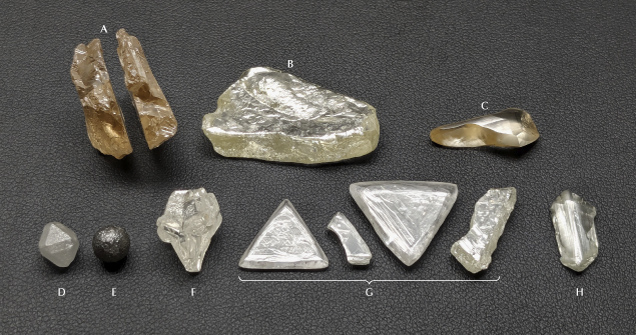
Diamonds form deep in the mantle when carbon-bearing fluids migrate and interact with solid rocks. Chemical reactions or other changes can decrease the solubility of carbon, forcing it to form solid crystals of diamond. In the simplest case, a growing diamond will take the shape of an octahedron. However, variations in growth conditions can lead to other shapes. By growing diamond crystals in different ways, nature can build diverse rough diamond shapes—as an artist might press clay together to create a masterpiece. Examples include variations of cubes (cuboids, cuboctahedra, re-entrant cubes with concave cube faces and protruding corners), spheres called ballas, and twinned triangular plates called macles (figure 1).
Despite its status as the hardest natural substance, diamond is not invincible. Natural stresses that squeeze or shear a diamond in the mantle or during transport to Earth’s surface in a kimberlite eruption can lead to fracture and cleavage. A diamond has four symmetrical planes within its crystal structure along which it can cleave, meaning that it can break apart with nearly perfect flat, smooth surfaces (see figure 1A). In addition to breakage, the shape and surface of a diamond can be refashioned by a process known as resorption. During resorption, hot fluids or magma in the earth partially etch away a diamond’s outer surface. Resorption affects the overall shape, turning sharp-edged octahedral crystals into rounded forms, and can also modify the surface texture through the creation of features including negative trigons, hillocks, and lustrous glossy surfaces (Robinson, 1979; Harris et al., 2022). Removing material from a diamond by breakage and resorption is akin to an artist taking a hammer and chisel to a block of marble. Mother Nature engages in both additive sculpture, by crystal growth, and subtractive sculpture, through breakage and resorption. The incredible array of natural diamond sculptures attests to the dynamic processes occurring deep beneath our feet over millions or billions of years.
NATURE'S WINDOWS
Geologists sometimes refer to diamonds as metaphorical windows into the mantle, but occasionally diamonds do emerge resembling windowpanes of glass. The transparent plate-like forms shown in figure 2 were created entirely by natural processes. Diamond can form excellent plates by cleavage, breaking along flat planes of weakness in the crystal structure. A single cleave may liberate the face of an octahedral crystal, for example, to make a flat plate shape. The 2.22 ct hexagonal-shaped specimen shown in tweezers in figure 2 was produced in this way. Examination using deep-UV luminescence shows that one side is the original exterior surface of the crystal, while the opposing face represents a cleave crosscutting multiple growth layers. Despite its incredible transparency, small negative trigons (not shown) decorate all sides of this diamond, testifying to its natural unpolished state. In addition to cleavage, twinning can produce flat transparent plates. Macle twinned diamonds tend to grow as flat triangular plates (again, see figure 2, left). Natural transparent diamond plates can therefore form by either growth or breakage.
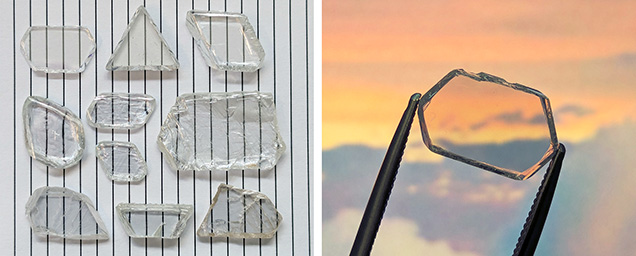
These shapes are evocative of portrait-cut diamonds, one of the earliest faceting styles, which some jewelers have recently repopularized. Portrait cuts possess two relatively large parallel facets and a thin profile and were originally intended for use as stylish protective covers for painted portraits. In a similar sense, diamond windows serve as transparent yet robust physical barriers in devices such as high-power laser systems and synchrotron beamlines. Diamond windows can have high transmission across the ultraviolet, visible, far-infrared, and microwave regions of the electromagnetic spectrum, which, combined with their thermal and chemical resistance and high strength, make them ideally suited for some modern high-tech applications.
RAW BAGUETTES
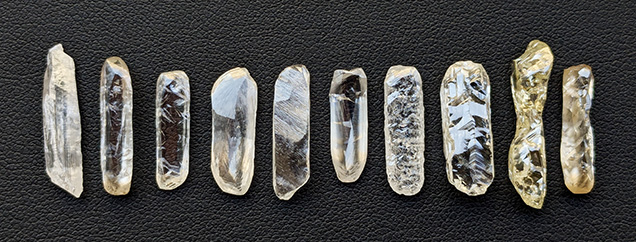
The elongated diamond forms shown in figure 3 are reminiscent of baguettes, both the cut style and the loaves of bread, though their shapes arise through crystal growth or natural breakage in the mantle. Whereas macle twinning provides a viable pathway to grow a natural plate-shaped diamond, there is no such straightforward mechanism to grow an elongate single crystal of diamond. That is not to say that it is impossible for a diamond to crystallize as an elongate rod, but the examples here appear to have been shaped by breakage. In nearly all cases, the direction of elongation is not random but is aligned with the internal crystal structure due to breakage that occurred along cleavage planes. Some are further sculpted by resorption, creating smooth, glossy finishes.
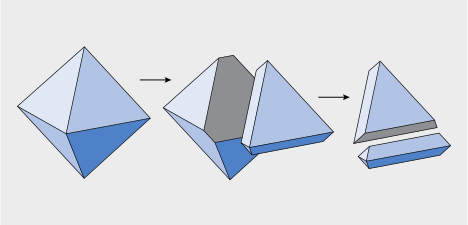
Among the specimens in figure 3, breakage has produced elongate diamonds in at least three distinct ways. The first is depicted in figure 4, with the faces of the octahedron parallel to the four different orientations of cleavage planes within a diamond crystal structure. Cleaving a plate from an octahedron (like those in figure 2) and then cleaving one of the edges off that plate along a cleavage plane of a different orientation can generate a fragment that is elongated in a <110> crystallographic direction.
The second and third ways that natural breakage has produced elongate rough diamonds are less intuitive and involve macle twins, as illustrated in figure 5. In the second mechanism, an edge is broken off a macle (figure 5A). The breakage surface is not planar because of the change in crystal structure orientation across the twin plane. If this break occurs purely by cleavage, the broken surface will be re-entrant, or angled inward, leaving sharp edges that are likely to be rounded off by resorption. Some broken fragments have more irregular or curved breaks (such as the two broken macles in figure 1).
In the third mechanism (figure 5B), the breakage produces a fragment that is elongate in a direction perpendicular to a macle edge. In this case, the breakage surfaces are parallel to {110} planes. Although they are not perfectly planar breaks, it is possible that the diamond is effectively cleaving because diamond does possess a rarely seen cleavage in this orientation (Brookes et al., 1990; Smith et al., 2017). Unlike diamond’s typical {111} cleavage planes, there are three possible {110} planes that transect the twin plane and will align perfectly between both portions of a macle twin. Alternatively, these broken surfaces could develop by the combined action of multiple {111} cleavage planes, creating finely stair-stepped breakage surfaces that average out to a {110} plane. Some of these broken surfaces develop a characteristic chevron pattern.
DIAMONDS RESEMBLING ANIMALS AND OBJECTS
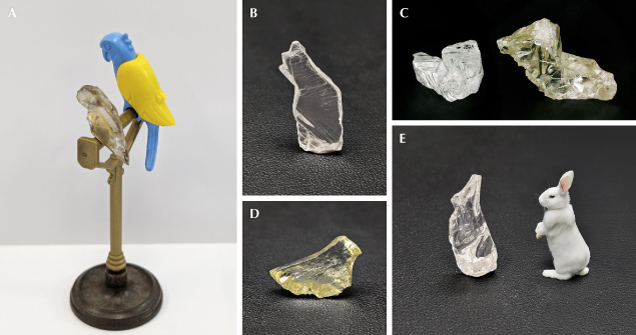
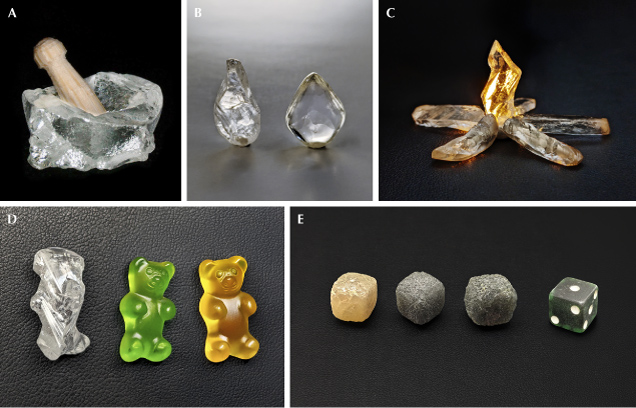
The complex sculpted forms of natural diamonds are fertile ground for lively imaginations. Depending on the lighting and viewing angle, some may resemble animals or familiar objects. Perceiving familiar shapes in inanimate forms such as clouds or rough diamonds is called pareidolia.
The basic shape of a rough diamond is all around us, from black diamonds on ski slopes to the familiar red diamonds in a standard deck of playing cards. These symbols are the silhouette of an octahedron, which is the archetypal diamond crystal. Indeed, the octahedron appears regularly within parcels of mined diamonds, but accompanying it are many other nuanced shapes, all sculpted by natural processes. GIA scientists recently had the opportunity to examine a suite of 264 rough diamonds handpicked over several years by Pintu Dholakia of Hari Krishna Exports for their unusual or interesting nature. Here we showcase some of these specimens to discuss their morphology and highlight their striking appearances.
SCULPTED BY NATURAL GROWTH, BREAKAGE, AND RESORPTION IN THE EARTH
Diamonds form deep in the mantle when carbon-bearing fluids migrate and interact with solid rocks. Chemical reactions or other changes can decrease the solubility of carbon, forcing it to form solid crystals of diamond. In the simplest case, a growing diamond will take the shape of an octahedron. However, variations in growth conditions can lead to other shapes. By growing diamond crystals in different ways, nature can build diverse rough diamond shapes—as an artist might press clay together to create a masterpiece. Examples include variations of cubes (cuboids, cuboctahedra, re-entrant cubes with concave cube faces and protruding corners), spheres called ballas, and twinned triangular plates called macles (figure 1).
Despite its status as the hardest natural substance, diamond is not invincible. Natural stresses that squeeze or shear a diamond in the mantle or during transport to Earth’s surface in a kimberlite eruption can lead to fracture and cleavage. A diamond has four symmetrical planes within its crystal structure along which it can cleave, meaning that it can break apart with nearly perfect flat, smooth surfaces (see figure 1A). In addition to breakage, the shape and surface of a diamond can be refashioned by a process known as resorption. During resorption, hot fluids or magma in the earth partially etch away a diamond’s outer surface. Resorption affects the overall shape, turning sharp-edged octahedral crystals into rounded forms, and can also modify the surface texture through the creation of features including negative trigons, hillocks, and lustrous glossy surfaces (Robinson, 1979; Harris et al., 2022). Removing material from a diamond by breakage and resorption is akin to an artist taking a hammer and chisel to a block of marble. Mother Nature engages in both additive sculpture, by crystal growth, and subtractive sculpture, through breakage and resorption. The incredible array of natural diamond sculptures attests to the dynamic processes occurring deep beneath our feet over millions or billions of years.
NATURE'S WINDOWS
Geologists sometimes refer to diamonds as metaphorical windows into the mantle, but occasionally diamonds do emerge resembling windowpanes of glass. The transparent plate-like forms shown in figure 2 were created entirely by natural processes. Diamond can form excellent plates by cleavage, breaking along flat planes of weakness in the crystal structure. A single cleave may liberate the face of an octahedral crystal, for example, to make a flat plate shape. The 2.22 ct hexagonal-shaped specimen shown in tweezers in figure 2 was produced in this way. Examination using deep-UV luminescence shows that one side is the original exterior surface of the crystal, while the opposing face represents a cleave crosscutting multiple growth layers. Despite its incredible transparency, small negative trigons (not shown) decorate all sides of this diamond, testifying to its natural unpolished state. In addition to cleavage, twinning can produce flat transparent plates. Macle twinned diamonds tend to grow as flat triangular plates (again, see figure 2, left). Natural transparent diamond plates can therefore form by either growth or breakage.
These shapes are evocative of portrait-cut diamonds, one of the earliest faceting styles, which some jewelers have recently repopularized. Portrait cuts possess two relatively large parallel facets and a thin profile and were originally intended for use as stylish protective covers for painted portraits. In a similar sense, diamond windows serve as transparent yet robust physical barriers in devices such as high-power laser systems and synchrotron beamlines. Diamond windows can have high transmission across the ultraviolet, visible, far-infrared, and microwave regions of the electromagnetic spectrum, which, combined with their thermal and chemical resistance and high strength, make them ideally suited for some modern high-tech applications.
RAW BAGUETTES
The elongated diamond forms shown in figure 3 are reminiscent of baguettes, both the cut style and the loaves of bread, though their shapes arise through crystal growth or natural breakage in the mantle. Whereas macle twinning provides a viable pathway to grow a natural plate-shaped diamond, there is no such straightforward mechanism to grow an elongate single crystal of diamond. That is not to say that it is impossible for a diamond to crystallize as an elongate rod, but the examples here appear to have been shaped by breakage. In nearly all cases, the direction of elongation is not random but is aligned with the internal crystal structure due to breakage that occurred along cleavage planes. Some are further sculpted by resorption, creating smooth, glossy finishes.
Among the specimens in figure 3, breakage has produced elongate diamonds in at least three distinct ways. The first is depicted in figure 4, with the faces of the octahedron parallel to the four different orientations of cleavage planes within a diamond crystal structure. Cleaving a plate from an octahedron (like those in figure 2) and then cleaving one of the edges off that plate along a cleavage plane of a different orientation can generate a fragment that is elongated in a <110> crystallographic direction.
The second and third ways that natural breakage has produced elongate rough diamonds are less intuitive and involve macle twins, as illustrated in figure 5. In the second mechanism, an edge is broken off a macle (figure 5A). The breakage surface is not planar because of the change in crystal structure orientation across the twin plane. If this break occurs purely by cleavage, the broken surface will be re-entrant, or angled inward, leaving sharp edges that are likely to be rounded off by resorption. Some broken fragments have more irregular or curved breaks (such as the two broken macles in figure 1).
In the third mechanism (figure 5B), the breakage produces a fragment that is elongate in a direction perpendicular to a macle edge. In this case, the breakage surfaces are parallel to {110} planes. Although they are not perfectly planar breaks, it is possible that the diamond is effectively cleaving because diamond does possess a rarely seen cleavage in this orientation (Brookes et al., 1990; Smith et al., 2017). Unlike diamond’s typical {111} cleavage planes, there are three possible {110} planes that transect the twin plane and will align perfectly between both portions of a macle twin. Alternatively, these broken surfaces could develop by the combined action of multiple {111} cleavage planes, creating finely stair-stepped breakage surfaces that average out to a {110} plane. Some of these broken surfaces develop a characteristic chevron pattern.
DIAMONDS RESEMBLING ANIMALS AND OBJECTS
The complex sculpted forms of natural diamonds are fertile ground for lively imaginations. Depending on the lighting and viewing angle, some may resemble animals or familiar objects. Perceiving familiar shapes in inanimate forms such as clouds or rough diamonds is called pareidolia.
.jpg "YMAL GIA Ed")