
[
  {
    "code": "too_small",
    "minimum": 1,
    "type": "string",
    "inclusive": true,
    "exact": false,
    "message": "Link href is required",
    "path": [
      "link",
      "href"
    ]
  }
]- Block type (mgnl:type):
- button
- Block index:
- 0
- Path:
- /gia-website/gems-gemology/fall-2024-microworld-metallic-platelets-in-morganite/contentBlocks/5
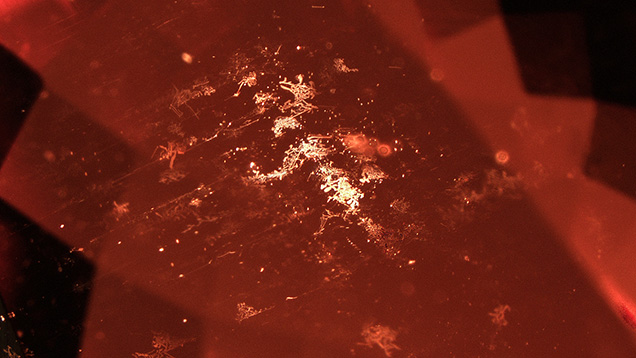
Reflective thin films were observed in an 18.67 ct pinkish orange morganite (see above). Since morganite’s subtle color is caused by traces of manganese, these films may have been natural metallic manganese, similar to the skeletal formations of natural metallic copper in Paraíba tourmaline (Summer 2023 G&G Micro-World, p. 229). Like many gems found in pegmatites (such as aquamarine, another beryl variety), morganite can form large crystals and usually does not contain eye-visible inclusions. Pegmatite is an igneous rock formed deep in the earth’s crust from the fluids that remain after solidified crystals break away from hot granitic magma as it gradually cools. The fluids have low viscosity and contain many elements that are important components for gems. The elements can move quickly in the fluids, so pegmatites contain many large and clean gems.
At first glance, this morganite appeared to be eye clean. However, when the planar thin films aligned between the microscope objective lens and the fiber-optic light satisfied a total reflection condition, the skeletal platelets appeared. When examining gemstones through a microscope, gemologists are often surprised to discover unexpected inclusions.
[
  {
    "code": "too_small",
    "minimum": 1,
    "type": "string",
    "inclusive": true,
    "exact": false,
    "message": "Link href is required",
    "path": [
      "link",
      "href"
    ]
  }
]- Block type (mgnl:type):
- button
- Block index:
- 0
- Path:
- /gia-website/gems-gemology/fall-2024-microworld-metallic-platelets-in-morganite/contentBlocks/5
Reflective thin films were observed in an 18.67 ct pinkish orange morganite (see above). Since morganite’s subtle color is caused by traces of manganese, these films may have been natural metallic manganese, similar to the skeletal formations of natural metallic copper in Paraíba tourmaline (Summer 2023 G&G Micro-World, p. 229). Like many gems found in pegmatites (such as aquamarine, another beryl variety), morganite can form large crystals and usually does not contain eye-visible inclusions. Pegmatite is an igneous rock formed deep in the earth’s crust from the fluids that remain after solidified crystals break away from hot granitic magma as it gradually cools. The fluids have low viscosity and contain many elements that are important components for gems. The elements can move quickly in the fluids, so pegmatites contain many large and clean gems.
At first glance, this morganite appeared to be eye clean. However, when the planar thin films aligned between the microscope objective lens and the fiber-optic light satisfied a total reflection condition, the skeletal platelets appeared. When examining gemstones through a microscope, gemologists are often surprised to discover unexpected inclusions.
.jpg "YMAL GIA Ed")