
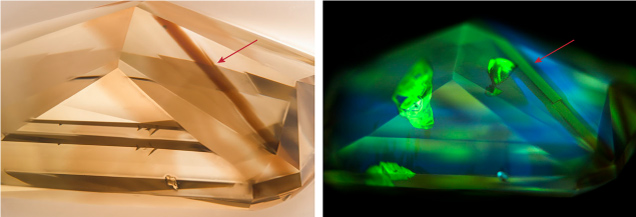
The author recently encountered a 2.21 ct Fancy Dark yellow-brown rectangular diamond with unusually strong eye-visible linear brown zoning (see above, left). This stone provided a unique opportunity to document crystallographic defects coloring a diamond with various instrumentation and tools in separate lighting conditions. The diamond’s ultraviolet/visible/near-infrared absorption spectra revealed a 480 nm absorption band, a defect gemologists know little about due to the complex mantle environment these diamonds come from (C.M. Breeding et al., “Naturally colored yellow and orange gem diamonds: The nitrogen factor,” Summer 2020 G&G, pp. 194–219). Prior research has shown that the 480 nm band defect coincides with dull yellow-green fluorescence (M.Y. Lai et al., “Spectroscopic characterization of diamonds colored by the 480 nm absorption band,” Diamond and Related Materials, Vol. 142, 2024, article no. 110825). Deep UV fluorescence imaging of this diamond showed several regions with dull yellow-green fluorescence corresponding with brown zoning. This defect was present not only in the brown band of color but also in the other areas of the stone that showed a dull yellow-green fluorescence (see above, right).
The figure above (right) also shows regions with blue fluorescence that are associated with the N3 defect (three substitutional nitrogen atoms adjacent to a vacancy). The bright green blocky color zones are associated with a concentrated H3 defect (two nitrogen atoms adjacent to a vacancy). Although the DiamondView image unveiled previously hidden defects, inert areas between the growth zones were not so easily explained. These images juxtaposed with one another provide a visually intriguing example of how defects in diamond can influence color.
The author recently encountered a 2.21 ct Fancy Dark yellow-brown rectangular diamond with unusually strong eye-visible linear brown zoning (see above, left). This stone provided a unique opportunity to document crystallographic defects coloring a diamond with various instrumentation and tools in separate lighting conditions. The diamond’s ultraviolet/visible/near-infrared absorption spectra revealed a 480 nm absorption band, a defect gemologists know little about due to the complex mantle environment these diamonds come from (C.M. Breeding et al., “Naturally colored yellow and orange gem diamonds: The nitrogen factor,” Summer 2020 G&G, pp. 194–219). Prior research has shown that the 480 nm band defect coincides with dull yellow-green fluorescence (M.Y. Lai et al., “Spectroscopic characterization of diamonds colored by the 480 nm absorption band,” Diamond and Related Materials, Vol. 142, 2024, article no. 110825). Deep UV fluorescence imaging of this diamond showed several regions with dull yellow-green fluorescence corresponding with brown zoning. This defect was present not only in the brown band of color but also in the other areas of the stone that showed a dull yellow-green fluorescence (see above, right).
The figure above (right) also shows regions with blue fluorescence that are associated with the N3 defect (three substitutional nitrogen atoms adjacent to a vacancy). The bright green blocky color zones are associated with a concentrated H3 defect (two nitrogen atoms adjacent to a vacancy). Although the DiamondView image unveiled previously hidden defects, inert areas between the growth zones were not so easily explained. These images juxtaposed with one another provide a visually intriguing example of how defects in diamond can influence color.
.jpg "YMAL GIA Ed")