
Stones with fraudulent GIA inscriptions are frequently reported. To verify diamond identity, GIA recently announced a diamond matching service using GIA Match iD, based on laser inscription imaging. In most cases of fraud, the inscribed material is diamond (Fall 2017 Lab Notes, p. 366), but there has also been a report involving non-diamond materials (Fall 2020 Lab Notes, pp. 424–425). A similar case was recently identified.
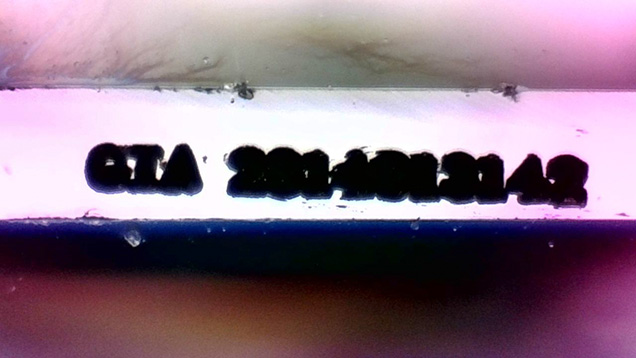
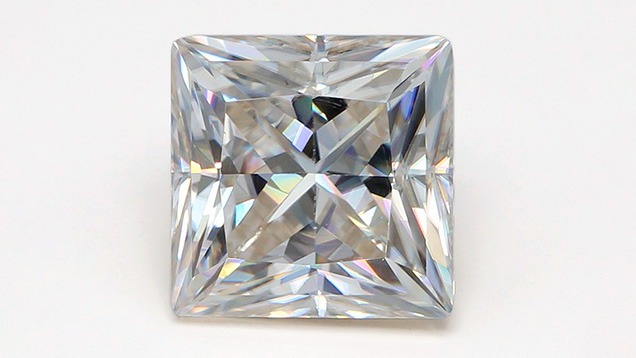
The Mumbai laboratory received a 1.71 ct square modified brilliant (figure 1) for update service. The girdle was inscribed with “GIA” and a number matching an existent report, although the font was different from that of an actual GIA inscription (figure 2). The inscribed report number matched one for a natural diamond, a 1.71 ct square modified brilliant cut. Compared with a typical laser inscription from the GIA laboratory, this one was significantly different. Gemological and spectroscopic examination confirmed that the brilliant was synthetic moissanite. In addition to diamonds and synthetic moissanite, GIA has previously identified laser inscriptions on cubic zirconia, diaspore, emerald, garnet, ruby, sapphire, spinel, tanzanite, and other materials.
Shoko Odake is senior manager of identification at GIA in Tokyo.
Stones with fraudulent GIA inscriptions are frequently reported. To verify diamond identity, GIA recently announced a diamond matching service using GIA Match iD, based on laser inscription imaging. In most cases of fraud, the inscribed material is diamond (Fall 2017 Lab Notes, p. 366), but there has also been a report involving non-diamond materials (Fall 2020 Lab Notes, pp. 424–425). A similar case was recently identified.
The Mumbai laboratory received a 1.71 ct square modified brilliant (figure 1) for update service. The girdle was inscribed with “GIA” and a number matching an existent report, although the font was different from that of an actual GIA inscription (figure 2). The inscribed report number matched one for a natural diamond, a 1.71 ct square modified brilliant cut. Compared with a typical laser inscription from the GIA laboratory, this one was significantly different. Gemological and spectroscopic examination confirmed that the brilliant was synthetic moissanite. In addition to diamonds and synthetic moissanite, GIA has previously identified laser inscriptions on cubic zirconia, diaspore, emerald, garnet, ruby, sapphire, spinel, tanzanite, and other materials.
Shoko Odake is senior manager of identification at GIA in Tokyo.
.jpg "YMAL GIA Ed")