
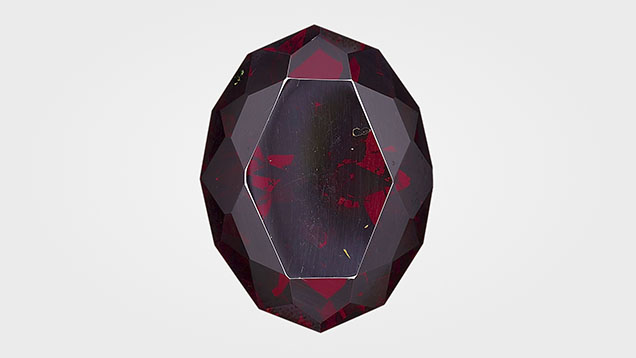
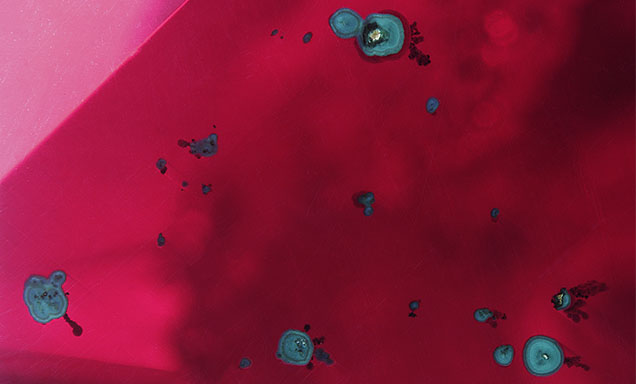
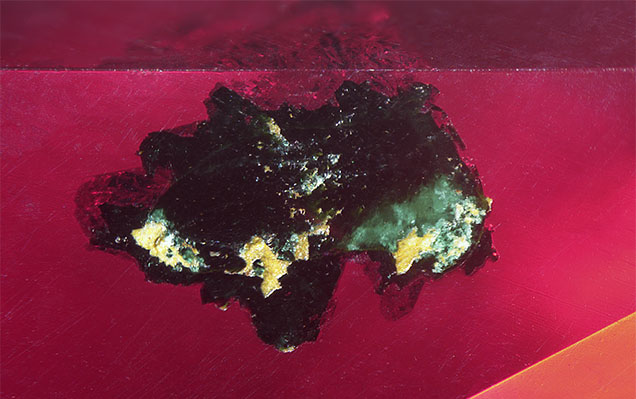
The Carlsbad laboratory recently examined a 100.15 ct transparent dark red gem submitted for an identification report (figure 1). An over-the-limit refractive index reading and submetallic luster were observed. Raman and infrared spectra were collected on the stone and concluded its identity as cuprite. This is the largest cuprite ever submitted to GIA. While its size alone makes the stone noteworthy, it also possessed photogenic malachite inclusions identified with Raman spectroscopy. Most were in the form of small, concentrically banded green aggregates breaking the surface of the pavilion (figure 2). But the most interesting inclusion was a cluster of dark green transparent malachite crystals breaking the crown (figure 3). Transparent crystals are uncommon for this mineral.
Cuprite is an oxide mineral with the simple chemical formula of Cu2O. It is a secondary mineral that forms in the oxidized zone of copper sulfide deposits. Large, gem-quality specimens are exceptionally rare and are most often sourced from a single deposit in Namibia. Cuprite is often found with malachite, a copper carbonate hydroxide mineral, along with azurite, chalcocite, and limonite. Gem-quality cuprite is mainly considered a collector’s stone. While the mineral has an attractive deep red hue and submetallic luster, its Mohs hardness is 3.5–4, making it generally too soft for use in jewelry.
Britni LeCroy is a senior staff gemologist at GIA in Carlsbad, California.
The Carlsbad laboratory recently examined a 100.15 ct transparent dark red gem submitted for an identification report (figure 1). An over-the-limit refractive index reading and submetallic luster were observed. Raman and infrared spectra were collected on the stone and concluded its identity as cuprite. This is the largest cuprite ever submitted to GIA. While its size alone makes the stone noteworthy, it also possessed photogenic malachite inclusions identified with Raman spectroscopy. Most were in the form of small, concentrically banded green aggregates breaking the surface of the pavilion (figure 2). But the most interesting inclusion was a cluster of dark green transparent malachite crystals breaking the crown (figure 3). Transparent crystals are uncommon for this mineral.
Cuprite is an oxide mineral with the simple chemical formula of Cu2O. It is a secondary mineral that forms in the oxidized zone of copper sulfide deposits. Large, gem-quality specimens are exceptionally rare and are most often sourced from a single deposit in Namibia. Cuprite is often found with malachite, a copper carbonate hydroxide mineral, along with azurite, chalcocite, and limonite. Gem-quality cuprite is mainly considered a collector’s stone. While the mineral has an attractive deep red hue and submetallic luster, its Mohs hardness is 3.5–4, making it generally too soft for use in jewelry.
Britni LeCroy is a senior staff gemologist at GIA in Carlsbad, California.
.jpg "YMAL GIA Ed")