
It is widely recognized that some gem minerals often occur together in various localities—either in the same host rock or in the same deposit. Gem minerals each require a certain set of physical and chemical conditions for their formation. This edition of the Colored Stones Unearthed column will explore where specific gem minerals are found together and the conditions that produce these distinct geological settings.
BACKGROUND
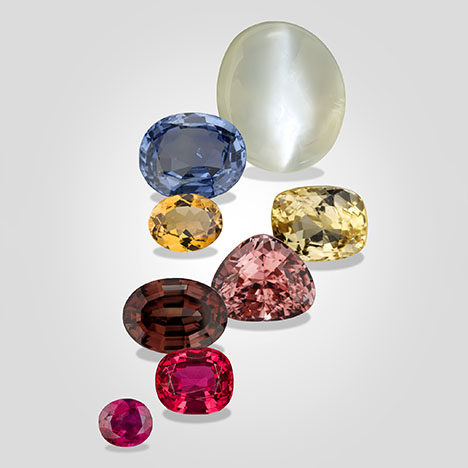
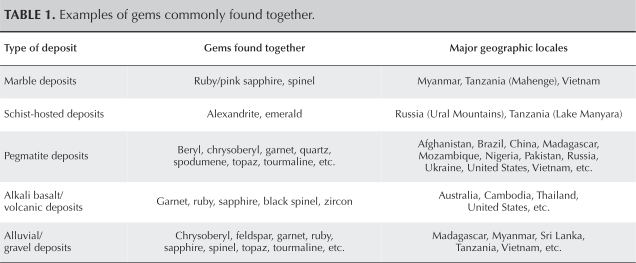
The most significant historic deposit of fine ruby is undeniably the Mogok Valley in Myanmar (formerly Burma). Yet, this deposit is recognized not only for yielding some of the world’s most important ruby, but also for a myriad of other fine gems (figure 1) from blue sapphire to peridot to spinel. Was it a stroke of luck that this relatively small region in Southeast Asia just happens to produce such an amazing diversity of gemstones, or is something more happening beneath the surface? The previous installment of Colored Stones Unearthed covered gems found in pegmatites. These pegmatitic deposits virtually always yield a number of different gemstones in the same deposit, rather than being single gem sources. In contrast, some gem deposits are known for producing almost exclusively one species of gemstone (e.g., the Mozambique ruby deposits, the Zambian emerald deposits, the Australian opal fields). In fact, it is quite common for multiple gems to be found in a single deposit (table 1). This contribution to Colored Stones Unearthed investigates deposits known for producing multiple gemstone species and places these deposits in a broader geological context.
WHY ARE SOME GEMS FOUND TOGETHER
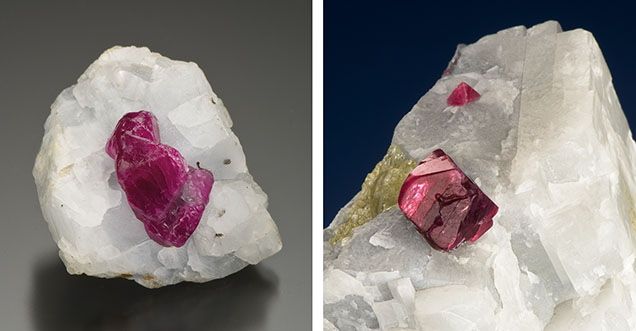
The assemblage of minerals that form in any situation is determined by the specific geological conditions including pressure, temperature, and local chemical environment. One instance of multiple gem species being found in the same deposit occurs when these species have overlapping chemical components but overall different chemical compositions. The simplest example is the Mogok Valley in Myanmar. Most of the major deposits here are alluvial. While the most well-known gem produced here is ruby, in many of the deposits, ruby and pink or red spinel are found in abundance. Though it is often stated anecdotally that ruby and spinel were indistinguishable until fairly recent mineralogical advancements, local mining communities in Mogok certainly understood these two mineral species were distinct and could distinguish between the two based on crystal morphology and other properties such as hardness. The chemical formulae for ruby (the red variety of corundum) and spinel are Al2O3 and MgAl2O4, respectively. Essentially the only chemical difference between ruby and red spinel, both colored by the presence of trace chromium, is the addition of magnesium to the nearly pure aluminum oxide comprising corundum (ruby). Fine mineral specimens of ruby and red spinel in marble are routinely recovered in Mogok (figure 2). The spinel-bearing specimens occur in a calcite (CaCO3) and dolomite (CaMg(CO3)2) marble, while ruby-bearing specimens occur in a marble that is nearly pure calcite. These specimens virtually never contain both ruby and spinel due to the fact that spinel crystallizes in these environments at the expense of corundum (ruby) when too much magnesium is present for corundum itself to form.
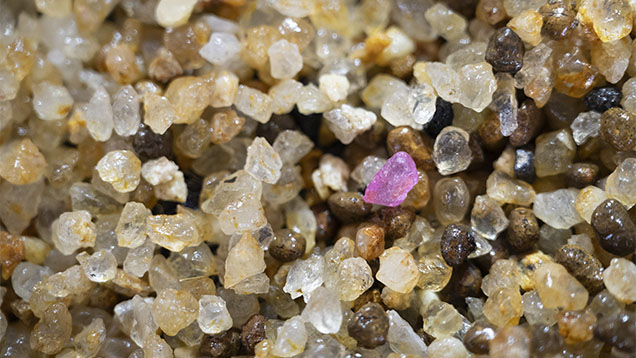
The following section describes several instances in which different gemstones form in a single deposit due to diversity in the chemical environment. The next section covers volcanic deposits, where multiple gems are brought to the surface from great depths by basaltic or other volcanic eruptions. In these cases, the ultimate origin of the different gems found in the same deposit are not clearly understood, but there is almost certainly some genetic link. The final section discusses alluvial or secondary deposits, in which intense, usually tropical, weathering pulls gemstones from multiple geological formations across a broad area, gathering several different gem species together. In many cases, the gems found in these secondary deposits clearly have disparate geological origins involving entirely different formation conditions. The clearest example of this is gem-bearing gravels containing both corundum (ruby or sapphire) and gemmy quartz (figure 3). Under most circumstances, this is impossible as corundum and quartz cannot form in equilibrium at most conditions within the earth’s crust1.
<
1Some exceptional cases of coexisting corundum and quartz assemblages have been documented, although it is unclear if these represent equilibrium or non-equilibrium mineralogical assemblages (Guiraud et al., 1996; Tsunogae and van Reenen, 2006).
It is widely recognized that some gem minerals often occur together in various localities—either in the same host rock or in the same deposit. Gem minerals each require a certain set of physical and chemical conditions for their formation. This edition of the Colored Stones Unearthed column will explore where specific gem minerals are found together and the conditions that produce these distinct geological settings.
.jpg "YMAL GIA Ed")