
Before a gemstone is fashioned by a lapidary, it enters the gem trade in its natural state, in a form generally referred to as “rough” or “gem rough.” Not all rough is gem quality, nor is most so-called rough appropriate for fine mineral collections. Only a very special piece of rough is suitable for gem use or fits the visual definition of a fine mineral specimen. When such crystals are encountered it then becomes a difficult decision, often financially based, whether to leave them in a natural state or fashion them into polished gems.
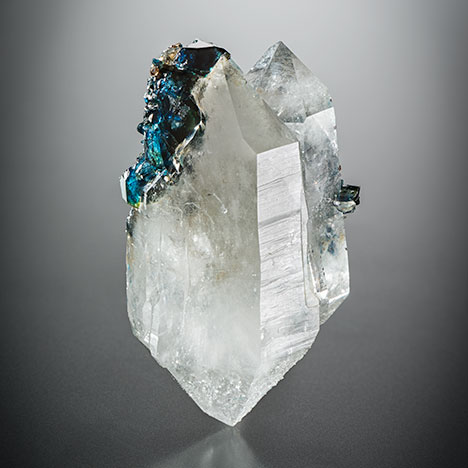
Our new “Quarterly Crystal” section of the Micro-World column will feature very attractive inclusion-bearing minerals that could also be fashioned by a skilled lapidary into a gem or a polished inclusion study block. The quartz and lazulite specimen shown in figure 1 is one such mineral.
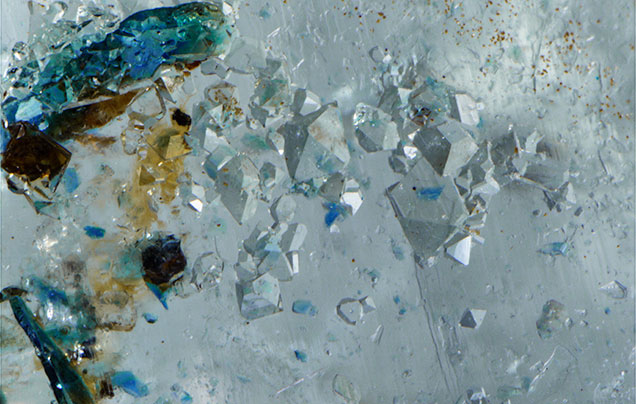
These parallel-growth, doubly terminated glassy quartz crystals were recovered from Rapid Creek in the Dawson mining district of Canada’s Yukon Territory. While this is a nearly perfect mineral specimen, hosting swarms of deep blue lazulite crystals both on the surface and within (figure 2), it also makes a remarkable piece for any inclusionist’s collection. Since this is a very uncommon mineral association from the locality, whether to polish it is a difficult decision. Fortunately, this dilemma can often be avoided with a simple trick: A small drop of mineral oil placed on the surface serves as a temporary window through which the inclusions may be observed and photographed.
Before a gemstone is fashioned by a lapidary, it enters the gem trade in its natural state, in a form generally referred to as “rough” or “gem rough.” Not all rough is gem quality, nor is most so-called rough appropriate for fine mineral collections. Only a very special piece of rough is suitable for gem use or fits the visual definition of a fine mineral specimen. When such crystals are encountered it then becomes a difficult decision, often financially based, whether to leave them in a natural state or fashion them into polished gems.
Our new “Quarterly Crystal” section of the Micro-World column will feature very attractive inclusion-bearing minerals that could also be fashioned by a skilled lapidary into a gem or a polished inclusion study block. The quartz and lazulite specimen shown in figure 1 is one such mineral.
These parallel-growth, doubly terminated glassy quartz crystals were recovered from Rapid Creek in the Dawson mining district of Canada’s Yukon Territory. While this is a nearly perfect mineral specimen, hosting swarms of deep blue lazulite crystals both on the surface and within (figure 2), it also makes a remarkable piece for any inclusionist’s collection. Since this is a very uncommon mineral association from the locality, whether to polish it is a difficult decision. Fortunately, this dilemma can often be avoided with a simple trick: A small drop of mineral oil placed on the surface serves as a temporary window through which the inclusions may be observed and photographed.
.jpg "YMAL GIA Ed")