
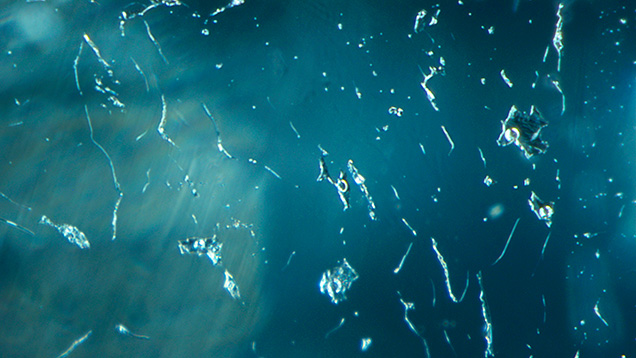
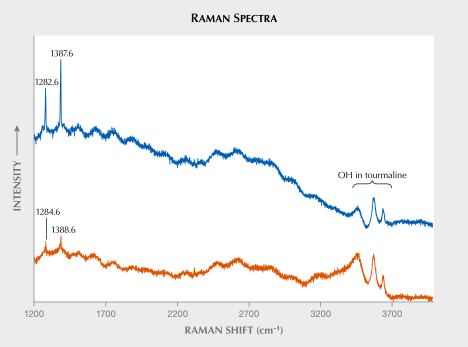
Recently, the authors encountered immiscible two-phase fluid inclusions in several Paraíba tourmaline stones. One stone weighed 0.48 ct and contained many two-phase inclusions (figure 1). Confocal Raman spectroscopy using a 100× objective lens detected carbon dioxide peaks of various intensities at around 1285 and 1388 cm–1 in the circular phases, identifying them as gaseous CO2 (L. Li et al., “In situ Raman spectral characteristics of carbon dioxide in a deep-sea simulator of extreme environments reaching 300°C and 30MPa,” Applied Spectroscopy, Vol. 72, No. 1, 2017, pp. 48–59) (figure 2), while no specific peaks were observed in the matrix phases. The most likely candidate for the matrix phase was liquid water (H2O; e.g., H. Beurlen et al., “Geochemical and geological controls on the genesis of gem-quality ‘Paraíba tourmaline’ in granitic pegmatites from northeastern Brazil,” Canadian Mineralogist, Vol. 49, No. 1, 2011, pp. 277–300), but it was difficult to detect because the Raman modes of O-H in tourmaline overlap with the two main O-H stretching modes at 3657 and 3756 cm–1 of liquid H2O (M.L. Frezzotti et al., “Raman spectroscopy for fluid inclusion analysis,” Journal of Geochemical Exploration, Vol. 112, 2012, pp. 1–20).
It is generally known that natural H2O-CO2 fluid inclusions can collapse when heated to approximately 350°C (R.J. Bodnar, “Introduction to aqueous-electrolyte fluid systems,” in I. Samson et al., Fluid Inclusions: Analysis and Interpretation, Mineralogical Association of Canada, Short Courses Vol. 32, 2003, pp. 81–99), which is lower than the conventional heating temperature of Paraíba tourmaline (Spring 1990 Gem News, p. 103). The immiscible coexistence of small amounts of gaseous CO2 and possible liquid H2O phases, and the absence of many tension fissures, may be evidence that the Paraíba tourmaline did not undergo heat treatment. To verify this, further heating experiments are needed.
Kazuko Saruwatari is manager of colored stone identification, and Taku Okada is a staff gemologist, at GIA in Tokyo.
Recently, the authors encountered immiscible two-phase fluid inclusions in several Paraíba tourmaline stones. One stone weighed 0.48 ct and contained many two-phase inclusions (figure 1). Confocal Raman spectroscopy using a 100× objective lens detected carbon dioxide peaks of various intensities at around 1285 and 1388 cm–1 in the circular phases, identifying them as gaseous CO2 (L. Li et al., “In situ Raman spectral characteristics of carbon dioxide in a deep-sea simulator of extreme environments reaching 300°C and 30MPa,” Applied Spectroscopy, Vol. 72, No. 1, 2017, pp. 48–59) (figure 2), while no specific peaks were observed in the matrix phases. The most likely candidate for the matrix phase was liquid water (H2O; e.g., H. Beurlen et al., “Geochemical and geological controls on the genesis of gem-quality ‘Paraíba tourmaline’ in granitic pegmatites from northeastern Brazil,” Canadian Mineralogist, Vol. 49, No. 1, 2011, pp. 277–300), but it was difficult to detect because the Raman modes of O-H in tourmaline overlap with the two main O-H stretching modes at 3657 and 3756 cm–1 of liquid H2O (M.L. Frezzotti et al., “Raman spectroscopy for fluid inclusion analysis,” Journal of Geochemical Exploration, Vol. 112, 2012, pp. 1–20).
It is generally known that natural H2O-CO2 fluid inclusions can collapse when heated to approximately 350°C (R.J. Bodnar, “Introduction to aqueous-electrolyte fluid systems,” in I. Samson et al., Fluid Inclusions: Analysis and Interpretation, Mineralogical Association of Canada, Short Courses Vol. 32, 2003, pp. 81–99), which is lower than the conventional heating temperature of Paraíba tourmaline (Spring 1990 Gem News, p. 103). The immiscible coexistence of small amounts of gaseous CO2 and possible liquid H2O phases, and the absence of many tension fissures, may be evidence that the Paraíba tourmaline did not undergo heat treatment. To verify this, further heating experiments are needed.
Kazuko Saruwatari is manager of colored stone identification, and Taku Okada is a staff gemologist, at GIA in Tokyo.
.jpg "YMAL GIA Ed")