

The authors recently examined two oval double cabochons consisting of chalcedony quartz, each with a multitude of glistening metallic native copper inclusions (figure 1, left). These gems were reportedly from Lawang Kori, Garut Regency, West Java Province, Indonesia, and weighed 43.04 and 46.68 ct, respectively, with corresponding measurements of 30.78 × 20.46 × 7.88 mm and 36.21 × 23.19 × 7.88 mm.
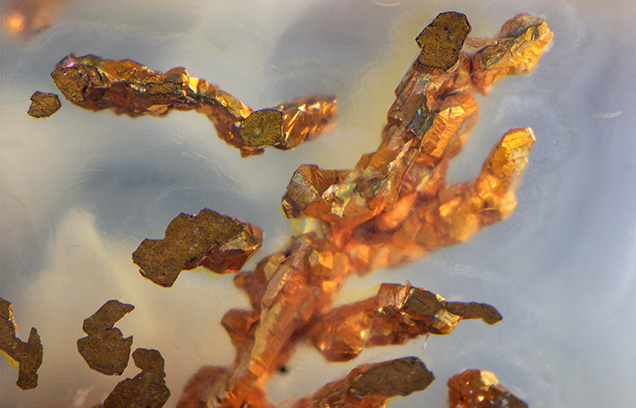
A chalcedony deposit was previously reported on Obi Island, Indonesia (J. Ivey and B.M. Laurs, “Copper minerals in chalcedony from Obi Island, Indonesia,” Journal of Gemmology, Vol. 38, No. 5, 2023, pp. 512–521), producing material containing an abundance of azurite, chrysocolla, cuprite, malachite, and other secondary copper minerals (figure 1, right). However, these secondary copper minerals are absent in the Lawang Kori material (figure 2).
This new material is ideal for cutting and takes an excellent polish, which should make it a marketable variety of chalcedony.
John Koivula is analytical microscopist, and Nathan Renfro is senior manager of colored stone identification, at GIA in Carlsbad, California.
The authors recently examined two oval double cabochons consisting of chalcedony quartz, each with a multitude of glistening metallic native copper inclusions (figure 1, left). These gems were reportedly from Lawang Kori, Garut Regency, West Java Province, Indonesia, and weighed 43.04 and 46.68 ct, respectively, with corresponding measurements of 30.78 × 20.46 × 7.88 mm and 36.21 × 23.19 × 7.88 mm.
A chalcedony deposit was previously reported on Obi Island, Indonesia (J. Ivey and B.M. Laurs, “Copper minerals in chalcedony from Obi Island, Indonesia,” Journal of Gemmology, Vol. 38, No. 5, 2023, pp. 512–521), producing material containing an abundance of azurite, chrysocolla, cuprite, malachite, and other secondary copper minerals (figure 1, right). However, these secondary copper minerals are absent in the Lawang Kori material (figure 2).
This new material is ideal for cutting and takes an excellent polish, which should make it a marketable variety of chalcedony.
John Koivula is analytical microscopist, and Nathan Renfro is senior manager of colored stone identification, at GIA in Carlsbad, California.