
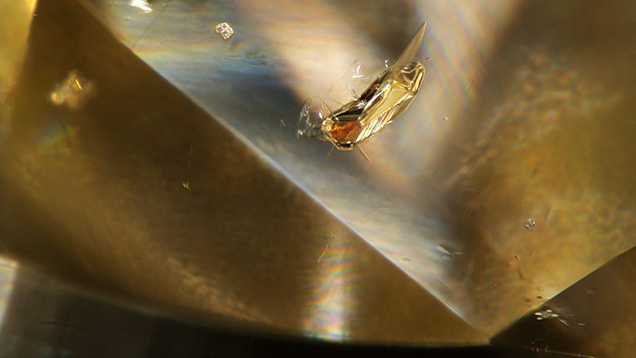
The authors recently examined a 0.75 ct type IaA Fancy Light brownish yellow diamond. This diamond, with a clarity grade of I1, contained at least 10 orange inclusions, the largest one ~500 μm in its longest dimension. A partially exposed orange inclusion resembled a flying insect, with “flapping wings” and “antennae” caused by fractures around the inclusion (see above). Raman spectroscopy revealed the inclusion to be pyrope-almandine-grossular garnet, (Mg,Fe,Ca)3Al2(SiO4)3, a major constituent mineral of eclogite.
Eclogite and peridotite are the major diamond host rocks in the lithospheric mantle. Worldwide, the ratio of diamonds with eclogitic mineral inclusions to those with peridotitic inclusions is ~1:2 (T. Stachel and J.W. Harris, “The origin of cratonic diamonds – constraints from mineral inclusions,” Ore Geology Reviews, Vol. 34, No. 1-2, 2008, pp. 5–32).
Although the presence of inclusions generally reduces a diamond’s clarity grade, diamonds containing visually identifiable mineral inclusions are uncommon. Studies of some smaller diamonds (~2 mm) from South Africa and Botswana revealed a low abundance of inclusion-bearing diamonds (about 1% in a total of one million diamonds examined; Stachel and Harris, 2008). For a gem-quality diamond to contain more than 10 mineral inclusions is therefore notable.
Mei Yan Lai is a postdoctoral research associate, and Taryn Linzmeyer is an analytics technician, at GIA in Carlsbad, California.
The authors recently examined a 0.75 ct type IaA Fancy Light brownish yellow diamond. This diamond, with a clarity grade of I1, contained at least 10 orange inclusions, the largest one ~500 μm in its longest dimension. A partially exposed orange inclusion resembled a flying insect, with “flapping wings” and “antennae” caused by fractures around the inclusion (see above). Raman spectroscopy revealed the inclusion to be pyrope-almandine-grossular garnet, (Mg,Fe,Ca)3Al2(SiO4)3, a major constituent mineral of eclogite.
Eclogite and peridotite are the major diamond host rocks in the lithospheric mantle. Worldwide, the ratio of diamonds with eclogitic mineral inclusions to those with peridotitic inclusions is ~1:2 (T. Stachel and J.W. Harris, “The origin of cratonic diamonds – constraints from mineral inclusions,” Ore Geology Reviews, Vol. 34, No. 1-2, 2008, pp. 5–32).
Although the presence of inclusions generally reduces a diamond’s clarity grade, diamonds containing visually identifiable mineral inclusions are uncommon. Studies of some smaller diamonds (~2 mm) from South Africa and Botswana revealed a low abundance of inclusion-bearing diamonds (about 1% in a total of one million diamonds examined; Stachel and Harris, 2008). For a gem-quality diamond to contain more than 10 mineral inclusions is therefore notable.
Mei Yan Lai is a postdoctoral research associate, and Taryn Linzmeyer is an analytics technician, at GIA in Carlsbad, California.
.jpg "YMAL GIA Ed")