
One common process used to alter gemstones is the “quench-crackle and dye” treatment, in which a heated stone is quenched in room-temperature water, inducing fractures that allow dye to penetrate the stone and change the appearance of its color. This technique was introduced in the 1990s (S.F. McClure and C.P. Smith, “Gemstone enhancement and detection in the 1990s,” Winter 2000 G&G, pp. 336–359) and is typically applied to quartz, cubic zirconia, glass, and other synthetic gemstones due to their low cost and high availability.
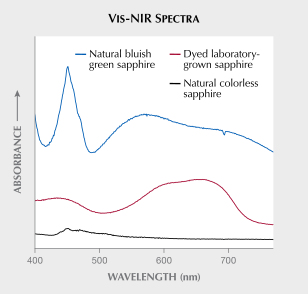
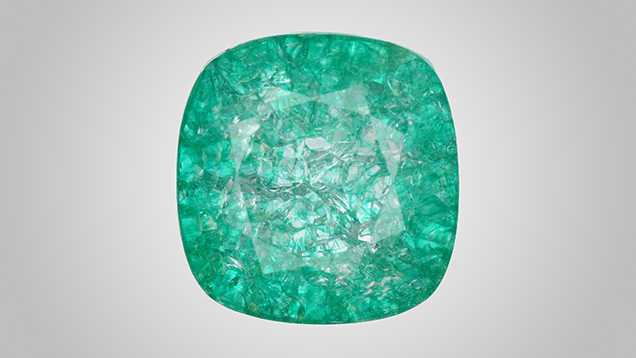
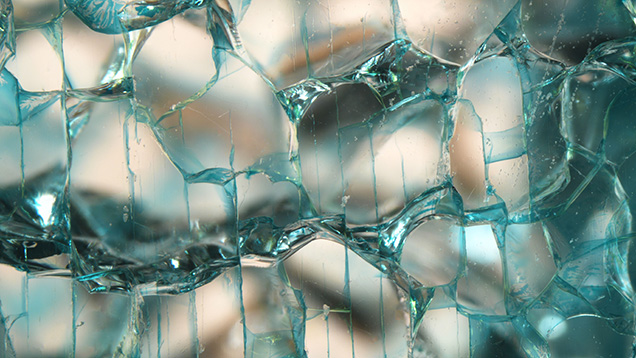
The Carlsbad laboratory recently received a 12.65 ct laboratory-grown colorless sapphire that showed signs of treatment (figure 1). At first glance, the overall face-up color of this stone suggested it was a Paraíba tourmaline or a low-quality emerald. With the unaided eye, the color-causing dye-filled fractures were faintly visible. The refractive index, specific gravity, and other basic gemological tests identified the material as sapphire. Along with the lack of natural inclusions, testing with X-ray fluorescence revealed the absence of both gallium and iron, confirming that the stone was laboratory-grown. Visible/near-infrared (Vis-NIR) absorption spectroscopy displayed a broad band around 650 nm that did not match natural color-causing components found in corundum (figure 2). This explains the unnatural color of this sapphire. With a microscope, the fractures within this stone displayed characteristic weblike fractures induced by quenching. Unlike naturally occurring fractures, the fractures produced by this type of treatment have uniform spacing and depth, as shown in figure 3.
Jamie Leigh Price is a staff gemologist at GIA in Carlsbad, California.
One common process used to alter gemstones is the “quench-crackle and dye” treatment, in which a heated stone is quenched in room-temperature water, inducing fractures that allow dye to penetrate the stone and change the appearance of its color. This technique was introduced in the 1990s (S.F. McClure and C.P. Smith, “Gemstone enhancement and detection in the 1990s,” Winter 2000 G&G, pp. 336–359) and is typically applied to quartz, cubic zirconia, glass, and other synthetic gemstones due to their low cost and high availability.
The Carlsbad laboratory recently received a 12.65 ct laboratory-grown colorless sapphire that showed signs of treatment (figure 1). At first glance, the overall face-up color of this stone suggested it was a Paraíba tourmaline or a low-quality emerald. With the unaided eye, the color-causing dye-filled fractures were faintly visible. The refractive index, specific gravity, and other basic gemological tests identified the material as sapphire. Along with the lack of natural inclusions, testing with X-ray fluorescence revealed the absence of both gallium and iron, confirming that the stone was laboratory-grown. Visible/near-infrared (Vis-NIR) absorption spectroscopy displayed a broad band around 650 nm that did not match natural color-causing components found in corundum (figure 2). This explains the unnatural color of this sapphire. With a microscope, the fractures within this stone displayed characteristic weblike fractures induced by quenching. Unlike naturally occurring fractures, the fractures produced by this type of treatment have uniform spacing and depth, as shown in figure 3.
Jamie Leigh Price is a staff gemologist at GIA in Carlsbad, California.